
Minimal Pairs in Mandarin: Training Your Ear to Distinguish Similar Sounds
Minimal pairs are the most efficient tool for retraining your brain to hear Chinese distinctions that English ignores.
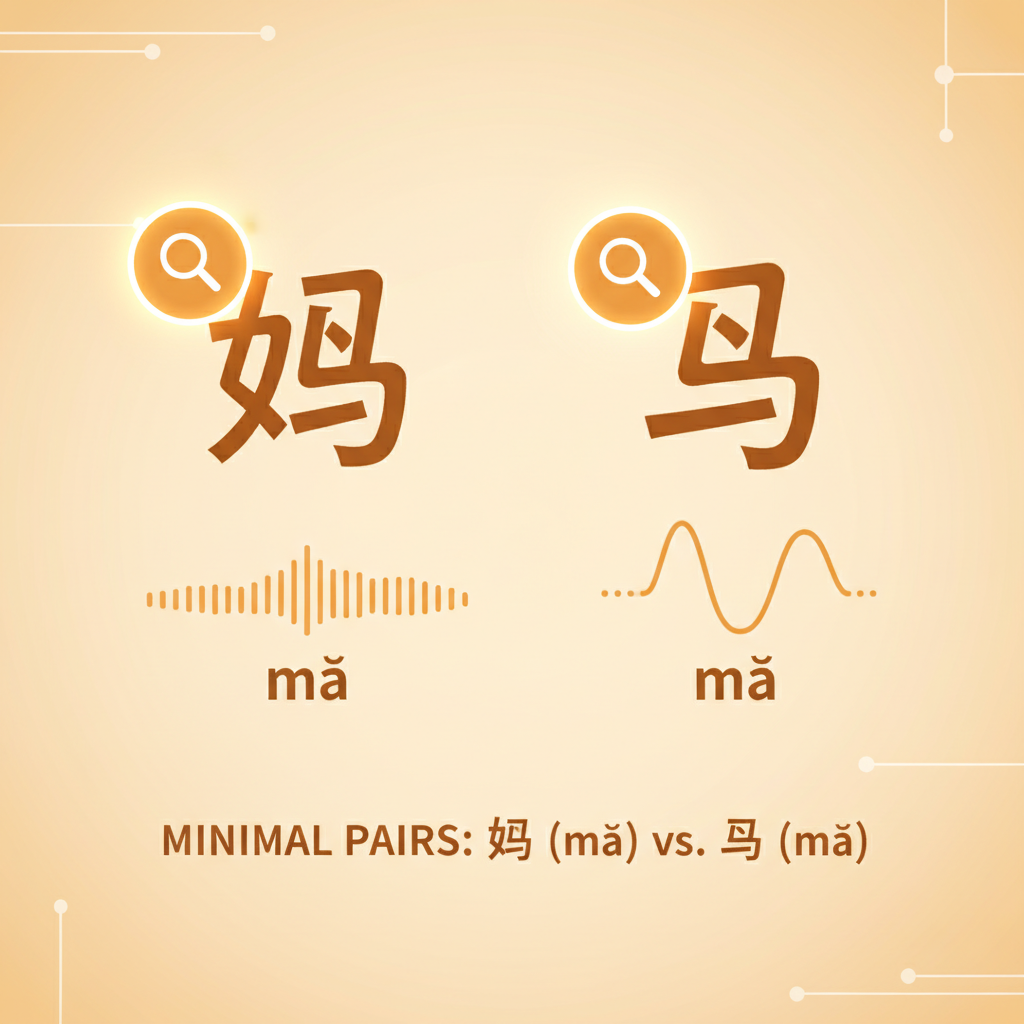
A minimal pair is two words that differ by only one sound. In English, "bat" and "pat" are a minimal pair -- they differ only in the initial consonant. In Mandarin, minimal pairs exist for both consonants and tones. "Ma" in first tone (mother) and "ma" in third tone (horse) are a tonal minimal pair. "Zhi" and "zi" are a consonantal minimal pair (retroflex vs flat tongue).
Minimal pair training forces your brain to focus on the exact acoustic feature that distinguishes two sounds. It is the most targeted form of perceptual training available and the one with the strongest research support for adults learning new sound distinctions.
Why Your Brain Needs This Training
During your first year of life, your brain underwent perceptual narrowing -- it strengthened its ability to distinguish sounds that matter in your native language and weakened its ability to distinguish sounds that do not. English does not use tone to change word meaning, so your brain learned to treat pitch as peripheral information. English does not distinguish retroflex from flat-tongue consonants, so your brain learned to treat them as the same sound.
As an adult, you can reverse this narrowing, but it requires deliberate, structured training. For a deeper look at how your brain processes tones and why retraining works, see our article on the science behind Chinese tones. Passive exposure (just listening to Chinese) recalibrates your perception very slowly. Active training with minimal pairs recalibrates it dramatically faster -- research suggests 20 to 25 times faster for the same amount of input.
Pro tip: The goal of minimal pair training is not memorization. It is perceptual recalibration. You are not learning facts -- you are retraining your auditory processing system to detect acoustic features it has been ignoring for decades. This is more like physical therapy than studying for a test.
Tonal Minimal Pairs
Tonal minimal pairs are the most important category for English speakers because tone is the dimension that English ignores most completely. Every Mandarin syllable forms minimal pairs across all four tones.
The Hardest Tonal Distinctions
Second tone vs third tone is the hardest distinction for most English speakers. Both involve pitch movement in a similar range. The second tone rises from mid to high. The third tone drops to low (and optionally rises at the end). In fast speech, the difference can be subtle.
First tone vs fourth tone is the second hardest distinction, not because the tones are similar in shape (one is flat, one falls sharply) but because English speakers sometimes produce a slightly falling first tone, making it indistinguishable from a gentle fourth tone.
Second tone vs first tone can also confuse beginners who do not rise enough on second tone, making it sound like a high flat first tone that started a bit lower.
Consonantal Minimal Pairs
Beyond tones, Mandarin has consonant distinctions that English does not make. The most important ones for minimal pair practice:
Key consonantal minimal pair categories:
- Retroflex vs flat: zh vs z, ch vs c, sh vs s. These differ only in tongue position (curled back vs flat) and sound identical to untrained English ears.
- Aspirated vs unaspirated: b vs p, d vs t, g vs k, j vs q, z vs c, zh vs ch. These differ in whether a puff of air follows the consonant.
- Palatal vs retroflex vs flat: j vs zh vs z, q vs ch vs c, x vs sh vs s. These three-way distinctions are among the most challenging for English speakers.
How to Practice Minimal Pairs Effectively
Effective minimal pair training follows a specific protocol. Simply listening to pairs is not enough -- the active judgment and feedback components are what drive perceptual change.
The minimal pair training protocol:
- Step 1: Listen to both words in the pair pronounced clearly, with labels. Know which is which.
- Step 2: Hear one of the two words at random and identify which one it is. This is the active judgment that drives learning.
- Step 3: Receive immediate feedback -- were you right or wrong? This feedback is essential. Without it, you are guessing, not learning.
- Step 4: If wrong, listen to both words again before the next trial. This reinforces the distinction.
- Step 5: Repeat for 50-100 trials per session. Research shows that meaningful perceptual change requires this volume of trials.
Session Structure
A single minimal pair practice session should last 10 to 15 minutes. Longer sessions produce diminishing returns because your auditory attention fatigues. Shorter sessions do not provide enough trials for meaningful learning.
Recommended session structure:
- Minutes 1-2: Warm up by listening to 5 clear examples of each sound in the pair you are training.
- Minutes 3-10: Active discrimination drills. Hear one sound, identify it, receive feedback. Aim for 60-80 trials.
- Minutes 11-12: Cool down with mixed pairs -- add a third or fourth sound to the discrimination task to increase difficulty.
- Record your accuracy percentage. You should see it climb from session to session.
Progression and Difficulty Scaling
Start with pairs that are easiest to distinguish and progress to harder ones. For tonal pairs, a typical progression is:
Tonal pair difficulty progression:
- Level 1: First tone vs fourth tone (most distinct pitch shapes)
- Level 2: First tone vs second tone, Fourth tone vs second tone
- Level 3: Second tone vs third tone (the hardest distinction for most)
- Level 4: All four tones mixed together in rapid identification
- Level 5: Tonal identification in connected speech (phrases and sentences) rather than isolated syllables
Within each level, also scale the speaking speed of the stimuli. Start with clearly pronounced, slightly slow examples. Progress to natural speed. Then progress to fast, casual speech where tones are partially reduced. Each speed increase is a new challenge for your perceptual system.
From Perception to Production
Minimal pair training is primarily a perception exercise. But perception gains transfer to production. Once you can reliably hear the difference between two sounds, you can monitor and correct your own production of those sounds. The transfer is not automatic -- you still need production practice -- but it is dramatically easier with a solid perceptual foundation.
A good practice sequence is: two weeks of perception-focused minimal pair training, then transition to production practice where you produce both words in a minimal pair and use recording or AI feedback to verify you are producing the distinction correctly. The perception training makes the production training much more efficient because you can hear whether you are getting it right.
"You cannot produce a distinction you cannot perceive. Minimal pair training is not a detour from speaking practice -- it is the prerequisite that makes speaking practice productive."
Train Your Ear with Structured Minimal Pair Drills
Our platform includes adaptive minimal pair exercises that identify your weakest sound distinctions and drill them with immediate feedback -- building the perceptual foundation your pronunciation needs.
Related Articles

Common Tone Pair Combinations That Trip Up Beginners (And How to Master Them)
Chinese Tone Drills: 15-Minute Daily Practice Routine for Tone Accuracy

The Science Behind Why Chinese Tones Are So Hard (And How to Finally Master Them)
Written by Conor Martin AI
Creator of the Learn Chinese for Beginners YouTube channel and the Chinese AI learning platform. Helping thousands of people start their Mandarin journey with clear, structured, no-nonsense teaching.
Enjoyed this article?