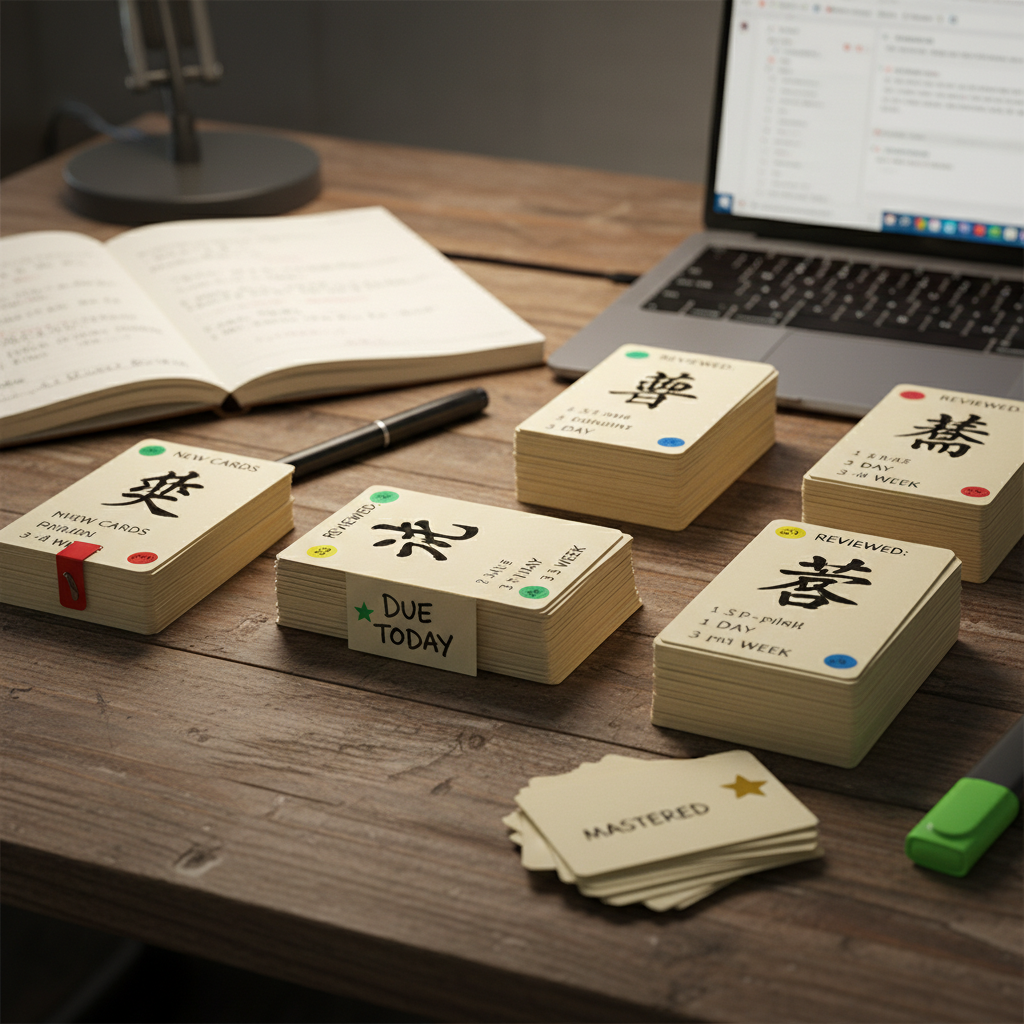
Best Website to Learn Chinese Characters Online with Spaced Repetition
Chinese characters are the longest challenge in Mandarin learning. Spaced repetition is the only evidence-based method for conquering it. Here is how to choose the right tool and use it correctly.
Chinese characters are the marathon of Mandarin learning. Tones are a sprint -- intense but short. Grammar is a middle distance -- challenging but finite. Characters are the event that never ends, because even after you learn 3,000, there are always more, and the ones you learned six months ago are fading unless you maintain them. Spaced repetition is the only proven method for making this marathon sustainable.
The science behind spaced repetition is simple and robust. When you learn a new piece of information, your memory of it decays over time following a predictable curve -- the forgetting curve, first described by Hermann Ebbinghaus in 1885. If you review the information just before you forget it, the memory is strengthened and the next forgetting interval is longer. By scheduling reviews at optimal intervals, you can maintain thousands of characters in long-term memory with remarkably little daily effort -- typically 10 to 20 minutes per day.
The question is not whether to use spaced repetition for characters -- the evidence is overwhelming. If you want to understand the science behind this approach, read about spaced repetition on Wikipedia. The question is which tool to use, how to set it up for Chinese characters specifically, and how to avoid the common mistakes that make spaced repetition feel like an endless grind instead of an efficient learning system.
What Makes a Good Character SRS Tool
Not all spaced repetition software is equally suited for Chinese characters. Characters have unique properties that standard flashcard tools may not handle well. Here are the features that matter specifically for character learning.
Essential features for character SRS:
- Audio for every card: Characters need to be linked to pronunciation. Silent flashcard review creates visual recognition without auditory association, which means you can read a character but cannot hear it in your head, which cripples reading fluency.
- Example sentences: Characters in isolation are harder to remember and less useful than characters in context. Every card should show the character in at least one example sentence.
- Radical decomposition: The best tools show how each character breaks down into its component radicals and phonetic elements. This transforms memorization into pattern recognition.
- Handwriting practice (optional but valuable): Tools that let you practice writing characters on screen build deeper memory traces than recognition-only review. The motor memory of stroke order reinforces visual recognition.
- Customizable card types: You should be able to review character-to-meaning, meaning-to-character, audio-to-character, and character-to-pronunciation as separate card types. Each direction tests a different skill.
- Mature spaced repetition algorithm: The algorithm should adjust intervals based on your performance history, not use fixed intervals. It should handle lapses (forgotten cards) by reducing intervals without resetting to zero.
The Major Tools Compared
Anki: The Customizable Powerhouse
Anki is the gold standard for spaced repetition and the most popular tool among serious Chinese learners. It is free on desktop, free on Android, and paid on iOS. Its algorithm (now FSRS in newer versions) is sophisticated and well-tested. Its card customization is unmatched -- you can create cards with audio, images, example sentences, radical breakdowns, stroke order animations, and any other information you want.
The strength of Anki is its total flexibility. You can download pre-made Chinese character decks containing thousands of cards with audio, or you can build your own cards tailored to your specific learning path. The community has created extensive shared decks organized by HSK level, frequency, radical, and topic.
The weakness of Anki is its learning curve and aesthetics. The interface looks like it was designed by engineers in 2006, because it was. Setting up optimal card templates, installing Chinese-specific add-ons, and configuring the algorithm for character learning requires technical effort that many learners find intimidating. Once configured, it is excellent. Getting to that point is not trivial.
Skritter: The Character Specialist
Skritter is designed specifically for Chinese and Japanese character learning. Its distinguishing feature is handwriting practice -- you draw characters on screen with your finger or stylus, and the app evaluates your stroke order, stroke direction, and character proportions. This motor practice creates deeper memory traces than passive recognition review.
Skritter includes built-in spaced repetition, native speaker audio, example sentences, and radical decomposition. Its content is curated by Chinese language educators and organized by textbook, HSK level, or topic. The user interface is polished and modern compared to Anki.
The weakness of Skritter is its cost (it requires a monthly subscription) and its focus on writing over recognition. If your goal is reading fluency rather than writing ability, the handwriting emphasis adds time to each review session without proportionally improving reading speed. For learners who want to write Chinese by hand, Skritter is best-in-class. For learners focused on reading, it provides more than necessary.
Pleco: The Dictionary with SRS
Pleco is primarily a Chinese dictionary -- the best one available -- with a built-in flashcard system that includes spaced repetition. Its unique advantage is integration with the dictionary: when you look up a word, you can add it to your flashcard deck with one tap. This creates a vocabulary review system that grows organically from your reading and study encounters.
Pleco's SRS is functional but less sophisticated than Anki's. Card customization is more limited. The interface for bulk card management is not as powerful. But for learners who want a simple, integrated tool that combines dictionary lookup with vocabulary review, Pleco's convenience is a significant advantage.
Dedicated Web Platforms
Several web-based platforms offer Chinese character learning with built-in spaced repetition as part of a larger learning ecosystem. These platforms typically provide characters within a structured curriculum rather than as standalone flashcard decks. The advantage is that character learning is integrated with vocabulary, grammar, and reading practice. The disadvantage is that you have less control over which characters you review and how the cards are formatted.
For learners who want character learning as part of a complete Chinese course rather than as a standalone activity, integrated platforms are often the better choice. For learners who want maximum control over their character study, standalone tools like Anki or Skritter are superior.

The Method Matters More Than the Tool
I have seen learners fail with the best tools and succeed with mediocre ones. The difference is always method, not software. Here are the principles that make character SRS effective regardless of which tool you choose.
Principle 1: Learn Radicals Before Characters
Before you start drilling individual characters, learn the 50 most common radicals as a separate study unit. Radicals are the building blocks of characters. Once you know them, every new character becomes a combination of known parts rather than an entirely novel symbol. This reduces the cognitive load per character dramatically and makes your SRS reviews faster and more effective.
For example, if you know the radical for "water" and the radical for "eye," learning the character that combines them becomes a meaningful association rather than an arbitrary shape. Multiply this effect across 3,000 characters and the compound time savings are enormous.
Principle 2: Context Over Isolation
A flashcard showing a single character with an English translation is the minimum viable card. It works, but poorly. A flashcard showing the character in a sentence, with audio, a radical breakdown, and a mnemonic is dramatically more memorable. The additional information creates multiple memory hooks that the single-translation card lacks.
The effort to create rich cards pays for itself many times over through faster learning and better retention. If you are using pre-made decks, choose ones that include sentences and audio. If you are making your own cards, invest the time to add context. Five minutes creating a good card saves 50 minutes of future failed reviews.
Principle 3: Keep Daily New Cards Manageable
The most common SRS mistake is adding too many new cards per day. Each new card creates future review obligations. Ten new cards today means 10 reviews tomorrow, plus reviews from previous days. At 20 new cards per day, your review queue grows to 100 to 150 cards within two weeks. At 30 new cards per day, it grows to 200+ cards within two weeks, and your daily review session stretches past 30 minutes, becoming an unsustainable burden.
Recommended daily new card limits:
- Beginning learners (first 3 months): 5-8 new characters per day. This produces a manageable review load and allows time for thorough initial learning.
- Intermediate learners (months 4-12): 8-12 new characters per day. Your reviews per card are now faster because your existing knowledge helps with related characters.
- Advanced learners (12+ months): 10-15 new characters per day. Review speed is fast enough to handle larger daily loads sustainably.
Pro tip: If your daily review session exceeds 20 minutes, you are probably adding new cards too fast. Reduce new cards until reviews stabilize at 15-20 minutes, then gradually increase. Sustainable pace beats ambitious pace every time. The learner who adds 5 cards daily for a year learns 1,825 characters. The learner who adds 20 cards daily for three months, burns out, and quits learns zero.
Principle 4: Never Skip Reviews
Adding new cards is optional any given day. Doing your reviews is not. The reviews are what prevent previously learned characters from fading. If you skip a day, the algorithm recalculates and adds more reviews to the next day. Skip two days and the backlog becomes intimidating. Skip a week and you face a mountain that takes hours to clear, which is exactly the kind of demoralizing experience that makes people quit.
On busy or tired days, do only reviews with zero new cards. This maintains your existing knowledge with minimal time investment (usually 5 to 10 minutes) and keeps the system stable. Adding new cards is the accelerator. Doing reviews is the steering wheel. You can take your foot off the accelerator temporarily. You cannot let go of the steering wheel.
Reading as the Ultimate Character Reinforcement
Spaced repetition maintains characters in memory. Reading reinforces them in context and builds the fluency that flashcards alone cannot provide. Once you know 500+ characters, begin reading graded Chinese text daily. Every character you encounter in natural reading is a contextual review that strengthens its memory trace differently than a flashcard does.
The combination of SRS for systematic maintenance and reading for contextual reinforcement is more powerful than either one alone. SRS ensures you do not forget characters you have learned. Reading ensures you can process those characters fluently in connected text. Both are necessary. Neither is sufficient.
My Recommendation
If you want maximum control and are willing to invest setup time: use Anki with a well-designed Chinese character deck that includes audio, sentences, and radical decomposition. Before diving in, make sure you have decided whether to study simplified or traditional Chinese characters first. The initial configuration effort pays off over months and years of daily use.
If you want writing practice specifically: use Skritter. Nothing else matches its handwriting evaluation quality for Chinese characters.
If you want simplicity and integration: use a learning platform with built-in SRS that integrates character review with vocabulary and grammar study. You sacrifice some customization for the convenience of having everything in one place.
Regardless of which tool you choose: learn radicals first, use rich cards with context, keep new card volume sustainable, and never skip reviews. These principles produce results with any tool. Violating them produces failure with even the best tool.
"The secret to learning 3,000 characters is not learning 3,000 characters. It is learning 5 characters today, 5 characters tomorrow, and doing your reviews every single day for 18 months. Spaced repetition makes the impossible merely tedious, and the tedious becomes automatic."
Learn Characters as Part of a Complete System
Our platform integrates character learning with spaced repetition, vocabulary building, and structured lessons. Characters are introduced within the context of your curriculum, reviewed at optimal intervals, and reinforced through reading practice. No separate tools needed.
Related Articles

Written by Conor Martin AI
Creator of the Learn Chinese for Beginners YouTube channel and the Chinese AI learning platform. Helping thousands of people start their Mandarin journey with clear, structured, no-nonsense teaching.
Enjoyed this article?