Should You Learn Simplified or Traditional Chinese Characters First?
The definitive answer depends on exactly one question -- and it is not the one you think.
This is one of the first questions every Chinese learner asks, and one of the most debated topics in the learning community. Forums are full of passionate arguments for both sides, often written by people who have already invested years in one system and feel compelled to defend their choice.
I am going to give you a straightforward answer, explain the reasoning, and save you from the rabbit hole of analysis paralysis that traps so many beginners before they even start.
The Quick History
Traditional characters are the older form, developed over thousands of years. They are used in Taiwan, Hong Kong, Macau, and many overseas Chinese communities. Simplified characters were introduced by the People's Republic of China in the 1950s and 1960s as part of a literacy campaign. They reduced the stroke count of many common characters to make reading and writing easier to learn. For a broader overview of the Chinese writing system, Omniglot's guide to Mandarin provides excellent context.
Mainland China, Singapore, and Malaysia use simplified characters as their standard. This means roughly 1.1 billion people use simplified and roughly 30 million use traditional as their primary system. Both systems are used in writing, education, government, and media in their respective regions.
It is important to understand that simplified and traditional are not two different languages. The spoken language is the same. The grammar is the same. The vocabulary is largely the same. They are two ways of writing the same language, like the difference between printing and cursive in English, but more extensive.
The One Question That Matters
Where do you plan to use your Chinese? That is the question. Everything else is noise.
If you are learning Chinese because of mainland China -- for business, travel, relationships, or general interest in Chinese culture -- learn simplified. If you are learning because of Taiwan or Hong Kong specifically -- you live there, you have family there, you plan to study there -- learn traditional.
If you have no specific regional connection and are learning "Chinese" in the general sense, learn simplified. This is not because simplified is better. It is because the vast majority of Chinese learning resources, textbooks, online content, and standardized tests (HSK) use simplified characters. The path of least resistance for a beginner is simplified, and beginners need every advantage they can get.
Pro tip: Do not let this decision delay you for even one day. Pick the one that matches your situation and start. You can learn the other system later -- many proficient Chinese readers can handle both. The worst choice is spending weeks debating instead of studying.
The Arguments for Simplified
Reasons to start with simplified characters:
- Fewer strokes per character means faster writing and (arguably) easier initial memorization
- The majority of learning resources and textbooks use simplified
- HSK and most standardized Chinese tests use simplified
- Mainland China represents the largest Chinese-speaking population and economy
- Most Chinese content on the internet is in simplified
- AI tools and translation services default to simplified in most cases
The Arguments for Traditional
Reasons to start with traditional characters:
- Traditional characters preserve the visual logic and etymology of the writing system -- radicals and components are more visually distinct
- Learning traditional first makes it easier to learn simplified later (the reverse is also true but slightly less intuitive)
- If your connection is to Taiwan or Hong Kong, using simplified characters would be impractical
- Classical Chinese texts, calligraphy, and historical documents use traditional characters
- Some argue that the internal logic of traditional characters makes them easier to remember despite higher stroke counts
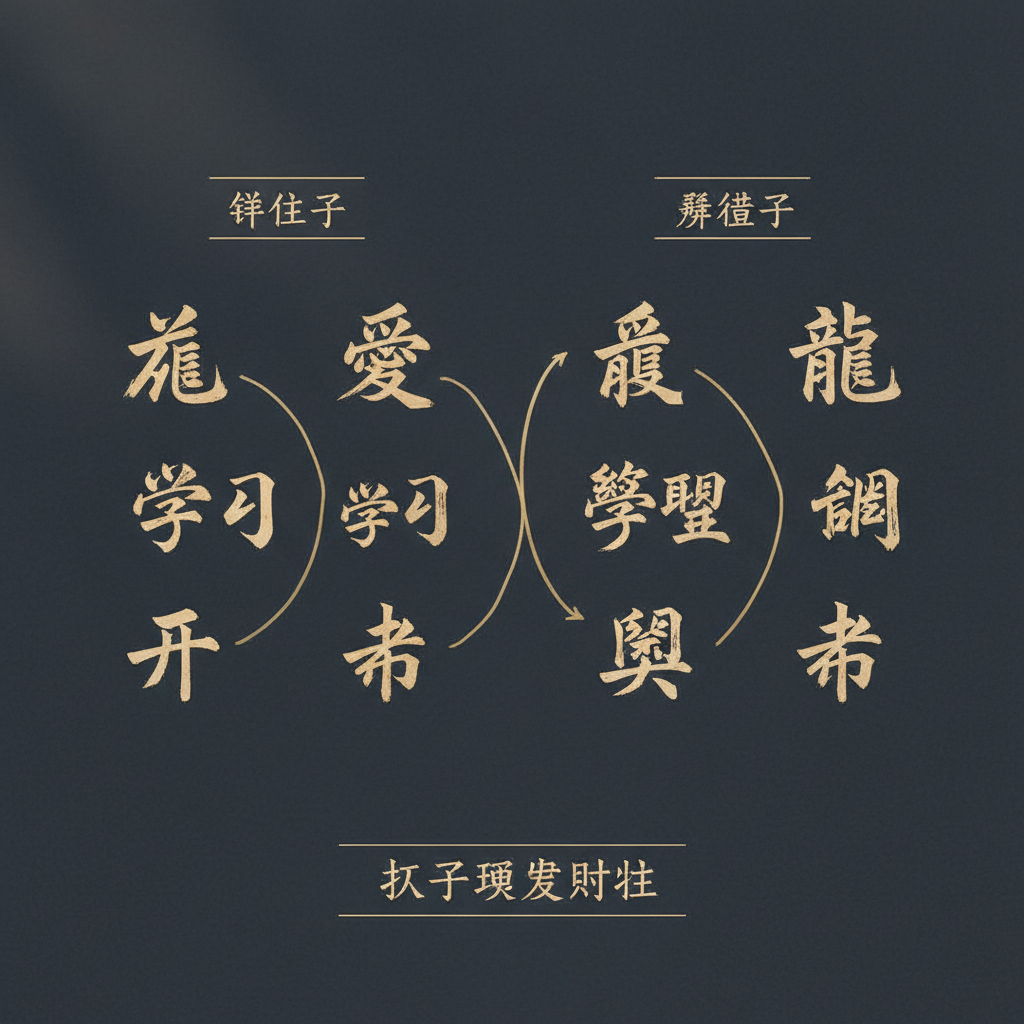
Common Myths Debunked
Myth: Traditional characters are much harder to learn
Not really. Traditional characters have more strokes on average, which means they take slightly longer to write by hand. But learning to recognize characters is about pattern recognition, not stroke counting. Your brain processes a 15-stroke character and a 25-stroke character in roughly the same way once you are familiar with the components. The difficulty difference in recognition is smaller than most people assume.
Myth: You need to learn both systems to be truly literate
Not as a beginner, and arguably not ever unless you need both for specific purposes. Most literate Chinese people primarily use one system. Mainlanders can often puzzle out traditional characters from context and component recognition, and vice versa, but comfortable reading in the non-native system takes dedicated practice.
Myth: Simplified characters are dumbed down
This is a value judgment, not a factual claim. Simplified characters were designed to increase literacy rates, and they succeeded -- China's literacy rate went from roughly 20 percent in the 1950s to over 96 percent today. The simplification process followed systematic rules and many simplified forms actually existed informally for centuries before being standardized.
The Bridge Between Systems
Here is something that should reduce your anxiety about this choice: roughly 30 percent of the most common characters are identical in both systems. Another 30 percent have minor differences. Only about 40 percent have substantial differences. So by learning one system well, you already have a significant head start on the other.
Many intermediate and advanced learners choose to learn the second system after achieving comfort with their first. The process typically takes a few months of focused study, not years, because you already understand the underlying language. You are only learning new visual forms for words you already know. Using spaced repetition for character learning makes this transition much smoother.
Making Your Decision
If you are still unsure, here is a simple decision framework. Answer these questions: Will you primarily interact with mainland Chinese people or content? Start with simplified. Do you have a specific connection to Taiwan or Hong Kong? Start with traditional. Are you learning for academic study of Chinese history or classical literature? Consider traditional. None of the above? Start with simplified.
And then stop thinking about it. The time and mental energy you spend deliberating over this choice is better spent learning characters -- any characters. Both systems lead to the same destination: the ability to read and write one of the world's great languages.
Start Learning Chinese Characters Today
Our platform teaches simplified characters with systematic radical breakdowns, making even the most complex characters approachable for absolute beginners.
Related Articles
Written by Conor Martin AI
Creator of the Learn Chinese for Beginners YouTube channel and the Chinese AI learning platform. Helping thousands of people start their Mandarin journey with clear, structured, no-nonsense teaching.
Enjoyed this article?