
How to Learn Mandarin Online Just for Reading Light Novels and Web Novels
A specialized guide for readers who want to access the vast world of Chinese web fiction in its original language -- with a learning path optimized for reading comprehension over speaking.
You are here because you want to read Chinese web novels and light novels in their original language. Maybe you have been reading machine translations on Novel Updates or WebNovel and noticed that the prose feels flat and repetitive. Maybe you have encountered cultivation terms that translators struggle with -- concepts so embedded in Chinese literary tradition that they lose their meaning in English. Maybe you just want to access the millions of novels that will never be translated because the market is too niche or the series too long.
Whatever your motivation, you have a specific goal that makes your learning path different from the standard "learn Mandarin" approach. You do not need perfect pronunciation. You do not need to hold conversations. You do not need to understand spoken Chinese at native speed. What you need is reading comprehension -- specifically, the ability to process Chinese characters at a speed fast enough to make reading novels enjoyable rather than agonizing.
This guide is designed for that specific goal. It prioritizes the skills that matter for reading fiction and deprioritizes or skips the skills that standard Chinese courses spend extensive time on but that you, as a reader, do not need. The result is a faster path to reading ability than a general-purpose Chinese course, at the cost of being unable to order food in Beijing. That is a tradeoff you have already decided to accept, and this guide respects that decision.
What Reading Chinese Fiction Actually Requires
Let me give you the honest numbers. A typical web novel chapter is 2,000 to 5,000 characters. A comfortable reading speed for Chinese adults is 400 to 600 characters per minute. To read a chapter in 10 to 15 minutes at a leisurely pace, you need to process about 300 characters per minute. That is the target. A beginning Chinese reader processes about 20 to 40 characters per minute, heavily reliant on dictionary lookups. The gap between 40 and 300 is large, and closing it takes sustained effort over months.
In terms of vocabulary, the average web novel uses somewhere between 5,000 and 8,000 unique words, though the most common 3,000 words will cover 90 to 95 percent of any given chapter. Genre-specific vocabulary adds another 500 to 1,000 words depending on the genre -- cultivation novels have their own lexicon, romance novels have theirs, and sci-fi has yet another. Your functional target for comfortable reading is approximately 3,500 to 4,000 words plus your genre-specific vocabulary.
For characters, you need to recognize roughly 2,500 to 3,000 unique characters. This sounds intimidating, but many of these characters appear in multiple words, and the radical system means that related characters share visual components. You are not memorizing 3,000 arbitrary symbols. You are learning a system, and the system becomes progressively easier to navigate as your knowledge grows.
Pro tip: The good news for novel readers: web fiction has a lower vocabulary barrier than formal writing. Web novel authors write for a mass audience and use conversational vocabulary, repetitive sentence structures, and genre conventions that reduce the cognitive load per page. A web novel at 3,000 words of vocabulary knowledge is more readable than a newspaper editorial at the same vocabulary level.
The Reading-First Learning Path
Standard Chinese courses balance speaking, listening, reading, and writing equally. Your path radically rebalances this. The allocation should be approximately: reading comprehension 50 percent, vocabulary acquisition 25 percent, grammar patterns 15 percent, and basic pronunciation 10 percent. Yes, pronunciation still matters -- you need to know how characters sound to anchor them in memory -- but you do not need to produce them accurately. You just need to hear them in your head while reading.
Phase 1: Foundation (Weeks 1-6)
Even for a reading-only goal, you need pinyin. Not because you will speak, but because pinyin is the bridge between characters and pronunciation, and pronunciation is the memory hook that makes characters stick. Learn all pinyin sounds and tones well enough to hear them mentally when you see pinyin notation. You do not need to produce them perfectly. You need to recognize them.
Spend the first two weeks on pinyin recognition and the 100 most common radicals. The radicals are critical for your reading path because they are the component parts from which all characters are built. A strong radical foundation means you can often guess the meaning or pronunciation category of an unfamiliar character, dramatically reducing your dictionary dependency.
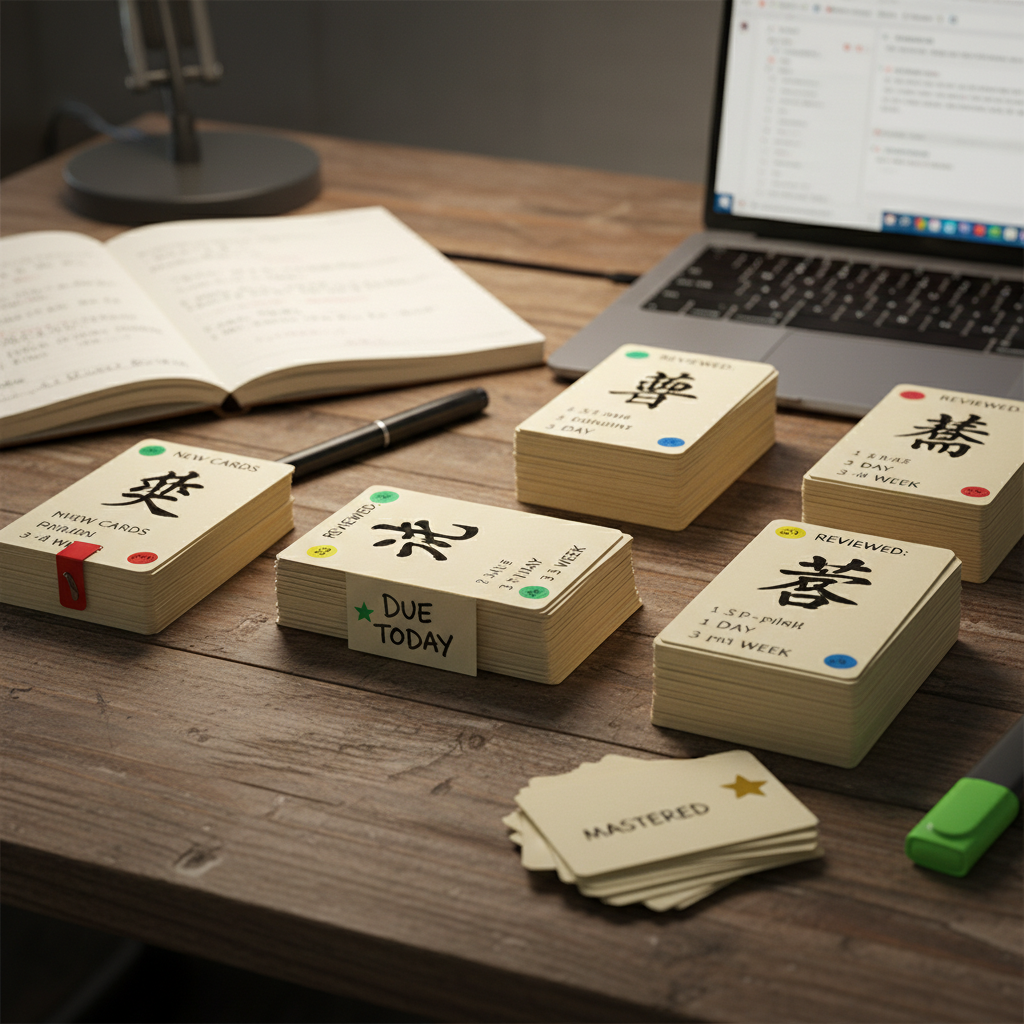
During weeks three through six, learn the 500 highest-frequency Chinese words with their characters. Use spaced repetition with character-to-meaning flashcards (not pinyin-to-meaning -- you need to train character recognition directly). Our guide to the best websites for learning Chinese characters with spaced repetition covers the most effective tools for this. For each word, learn it in the context of a sentence, not in isolation. This builds the pattern recognition needed for reading connected text.
Grammar during this phase should focus on the 20 most common sentence structures. Chinese grammar for reading purposes is more straightforward than for speaking because you have time to process complex sentences. Focus on subject-verb-object order, common particles (le, de, guo, zhe), question structures, and basic connectors (suoyi, keshi, yinwei, ruguo).

Phase 2: Graded Reading (Weeks 7-16)
This is the critical phase. You transition from studying Chinese to reading Chinese. Start with graded readers -- simplified texts written specifically for learners, using restricted vocabulary and simplified grammar. Begin at the lowest level, even if it feels painfully easy. The goal is to build reading fluency: the ability to process characters smoothly without stopping to decode each one.
The magic number for comfortable reading is recognizing 95 percent of the characters in a text without dictionary lookup. At 90 percent, reading is laborious but possible. Below 90 percent, it is too painful to sustain. Graded readers let you control this percentage by matching text difficulty to your current vocabulary.
Read extensively, not intensively. Intensive reading means stopping at every unknown word, looking it up, and memorizing it. Extensive reading means reading for flow and meaning, guessing unknown words from context, and only looking up words that are truly blocking comprehension. Extensive reading builds speed, fluency, and natural vocabulary acquisition. It is the closest thing to a shortcut that exists in language learning.
During this phase, continue adding vocabulary through spaced repetition. Your target is to reach 1,500 words by the end of week 16. The new words should increasingly come from your reading rather than from vocabulary lists -- when you encounter a word three times and still cannot remember it, that is when it goes into your spaced repetition deck.
Phase 3: Bridge to Native Content (Weeks 17-26)
Transition from graded readers to the easiest native content you can find. Children's stories, simplified news articles, and -- crucially for your goal -- the simplest web novels you can find. You can also supplement your reading with audio versions; see our roundup of the best Mandarin audiobook sites and apps for learners. Some web novel genres are much easier to read than others.
Web novel genres ranked by reading difficulty (easiest to hardest):
- Modern romance and slice-of-life: Contemporary vocabulary, simple descriptions, dialogue-heavy. Lowest vocabulary barrier of any genre.
- School-life and campus novels: Similar to modern romance with additional academic vocabulary. Still relatively accessible.
- Urban fantasy and modern cultivation: Contemporary base vocabulary plus a layer of genre-specific terms. Medium difficulty.
- Historical romance and palace intrigue: Literary vocabulary, formal speech patterns, historical references. Moderately challenging.
- Xianxia and high fantasy cultivation: Heavily genre-specific vocabulary, classical Chinese influences, complex world-building terminology. The hardest genre for learners but often the one that motivated them to learn in the first place.
- Classical wuxia: Deliberately archaic style, dense literary references, four-character idioms. The most linguistically demanding genre.
Start with modern romance or slice-of-life even if your ultimate target is xianxia. The base vocabulary and grammar patterns are the same across genres. Building fluency with easier content gives you the reading speed needed to tackle harder genres without the experience being excruciating.
The Web Novel Reader's Toolkit
Reading Chinese web novels requires specific tools that general Chinese learners do not use. Here is the stack that makes novel reading practical at intermediate levels.
Essential tools for reading Chinese web novels:
- Browser-based popup dictionary: Hover over any Chinese character to see its pronunciation and definition without leaving the page. This single tool transforms web reading from impossible to merely challenging. Several free options are excellent.
- Reading mode extensions: Strip web novel sites of their cluttered formatting and present clean text in a customizable font size. Larger character size significantly reduces reading fatigue for learners.
- Sentence parser: Tools that break Chinese sentences into their component words (Chinese does not use spaces between words) and provide word-by-word definitions. Essential for untangling complex sentences.
- Custom vocabulary tracker: Export unknown words from your reading sessions into your spaced repetition system. The best workflow is to mark words while reading and batch-add them to flashcards afterward, so you do not break your reading flow.
- Machine translation for comparison: When you read a passage you cannot parse, check a machine translation to see if your comprehension was correct. Use this as a safety net, not a crutch. If you are checking more than 10 percent of paragraphs, the text is too hard for your level.
Genre-Specific Vocabulary: The Cultivation Example
Since cultivation novels (xianxia and xuanhuan) are the genre that drives the most learners to study Chinese, here is a realistic assessment of the vocabulary challenge they present.
Cultivation novels use three layers of vocabulary. The base layer is standard modern Chinese -- the same words used in any contemporary writing. This is 70 to 80 percent of the text. The second layer is genre-specific terminology: cultivation stages, martial arts techniques, spiritual concepts, sect hierarchy, and artifact descriptions. This is 15 to 20 percent of the text and represents approximately 500 to 800 unique terms that repeat frequently within the genre. The third layer is the author's personal vocabulary: their particular way of describing combat, their invented cultivation systems, and their stylistic preferences. This is 5 to 10 percent and varies by author.
The second layer is learnable and transferable. Once you know that "dan" means spiritual pill, "jie" means realm or boundary, "qi" means vital energy, and "jian" means sword, these terms reappear across hundreds of novels. Building this genre vocabulary is a one-time investment that pays off across your entire reading career. Create a dedicated flashcard deck for cultivation terminology and front-load it alongside your general vocabulary study.
Pro tip: Many cultivation terms have roots in Daoist and Buddhist philosophy that predate web fiction by centuries. Learning these terms does not just help you read novels -- it gives you a window into Chinese philosophical and religious thought that is genuinely fascinating in its own right. The vocabulary is not arbitrary jargon. It is a living tradition.

Realistic Timeline and Milestones
Here is what to expect at each stage if you study 45 to 60 minutes per day with a reading-focused approach.
Timeline milestones for novel readers:
- Month 2: Can read graded readers at the lowest level (300-word vocabulary). Reading speed: 30-50 characters per minute with frequent dictionary lookups.
- Month 4: Can read intermediate graded readers (800-word vocabulary). Reading speed: 80-120 characters per minute. Starting to guess meaning from context.
- Month 6: Can read simple native content (modern romance, slice-of-life) with popup dictionary support. Reading speed: 150-200 characters per minute. Looking up about 20 words per page.
- Month 9: Can read most web novel genres with dictionary support. Reading speed: 200-250 characters per minute. Genre vocabulary starting to stick. Looking up about 10 words per page in familiar genres.
- Month 12: Can read cultivation novels with occasional dictionary lookups for new terms. Reading speed: 250-350 characters per minute. Can finish a chapter in 15-25 minutes. The experience starts feeling like reading rather than decoding.
- Month 18+: Comfortable reading across genres. Speed approaching native-comfortable levels for well-known genres. Dictionary use drops to 2-5 lookups per chapter. This is where reading becomes genuinely enjoyable rather than primarily educational.
These timelines are faster than what general Chinese courses produce for reading ability because you are allocating 50 percent of your study time to reading rather than the 20 to 25 percent that balanced courses allocate. The tradeoff is that your speaking and listening will be minimal. That is the deal you made when you chose this path.
The Painful Truth About the First Hundred Hours
The first 100 hours of reading Chinese are unpleasant. There is no way around this. Every sentence requires work. Your reading speed is glacial. Looking up every other word destroys narrative flow. You read a chapter that would take a native speaker five minutes, and it takes you an hour. The story you were excited about becomes a decoding exercise.
Push through this. It gets better in a nonlinear way. The first 500 characters you learn remove the most common words from your lookup burden. The next 500 remove the next tier. Each new word you learn has a cascading effect on your reading speed because high-frequency words appear on every page. By the time you know 2,000 words, your lookup rate drops from "every other word" to "a few per paragraph," and the reading experience transforms from painful decoding to something recognizable as reading.
The readers who make it through the first 100 hours almost always continue to fluency. The ones who quit almost always quit during those first 100 hours. Knowing this in advance gives you a powerful advantage: when it hurts, you know it is temporary and that the pain has an expiration date.
"Every character you learn is a character you will never have to look up again. And in a language where the same 3,000 characters account for 99 percent of all text, each one you master permanently reduces the barrier between you and the stories you want to read."
Build Your Reading Foundation with Structured Lessons
Our curriculum builds character recognition and vocabulary systematically, giving you the foundation needed to start reading native Chinese content months sooner. Pair our lessons with your reading practice to accelerate through the painful early phase.
Related Articles


Written by Conor Martin AI
Creator of the Learn Chinese for Beginners YouTube channel and the Chinese AI learning platform. Helping thousands of people start their Mandarin journey with clear, structured, no-nonsense teaching.
Enjoyed this article?