
Best Mandarin Audiobook Sites and Apps for Learners Outside China
Chinese audiobooks are an extraordinary learning resource that most learners outside China do not know how to access. Here is where to find them, how to choose the right ones, and how to use them for language acquisition.
China's audiobook market is enormous. Platforms like Ximalaya, Lizhi, and QQ Reading host millions of hours of Chinese audio content including professionally narrated novels, educational lectures, podcasts, radio dramas, and children's stories. For Chinese learners, this content represents a nearly infinite library of listening material at every difficulty level. The problem is that most of these platforms are designed for the Chinese domestic market, with interfaces entirely in Chinese, payment systems that require Chinese bank accounts, and content libraries that are geo-restricted to varying degrees.
This article maps out the landscape of Chinese audiobook resources accessible to learners outside China. Some require workarounds. Some are fully international. Some are free, some require payment. For each resource category, I will explain what content is available, how to access it, and most importantly, how to use audiobooks effectively as a language learning tool at different proficiency levels.
Why Audiobooks Are Uniquely Valuable for Chinese Learners
Audiobooks provide something that no other listening resource offers: extended, high-quality narration with consistent vocabulary and a known text that you can reference. For shorter-form alternatives, see our roundup of the best online Chinese listening practice with transcripts. Unlike podcasts, which jump between topics, audiobooks sustain a single narrative or topic across hours of content. This sustained exposure builds listening stamina -- the ability to maintain comprehension over extended periods rather than just for two-minute listening exercises.
Unlike conversation audio, audiobooks use clear, well-articulated Mandarin without the interruptions, false starts, and overlapping speech of natural dialogue. For intermediate learners who find conversation-speed Chinese overwhelming, audiobooks provide a bridge -- faster and more complex than learning materials but more structured and clearer than casual native speech.
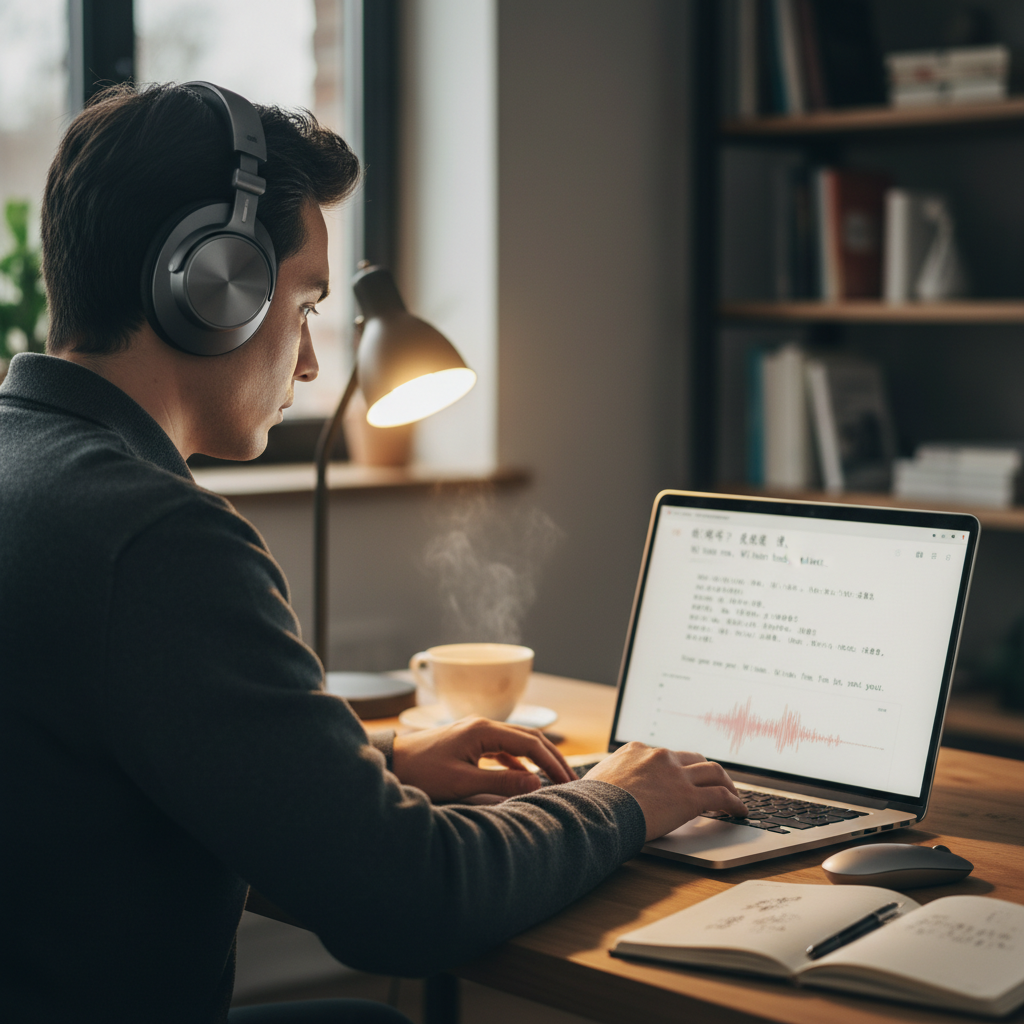
Most importantly, audiobooks come with a text. You can read along, look up words, and verify comprehension. You can listen to a chapter, read it, then listen again with dramatically improved understanding. This audio-text pairing is the most efficient format for building the connection between written Chinese (which most learners develop first) and spoken Chinese (which most learners struggle with).
Platforms and Resources by Accessibility
Fully Accessible Outside China
Several platforms provide Chinese audiobook content with no geographical restrictions and with payment systems that accept international credit cards.
YouTube and Bilibili both host thousands of hours of Chinese audiobook content uploaded by users and publishers. The quality varies enormously -- some uploads are professional narrations, others are amateur recordings -- but the breadth of content is unmatched. Search in Chinese for the genre you want (for example, "you sheng shu" meaning "audiobook" plus a genre term) and you will find extensive options. The content is free but ad-supported, and the audiobook may be split across dozens of short videos rather than organized as a single continuous file.
International audiobook platforms like Audible have small but growing Chinese language sections. The selection is limited compared to Chinese domestic platforms, but the content available is generally high quality -- professionally narrated versions of popular novels, business books, and self-help titles. The interface is in English, payment is straightforward, and downloads work worldwide.
LibriVox offers free audiobooks of Chinese public domain literature. The narrations are by volunteers, so quality varies, but classic works like "Journey to the West," "Dream of the Red Chamber," and selected works of Lu Xun are available in their original Chinese. These are excellent for advanced learners interested in classical and literary Chinese.
Accessible with Some Effort
Ximalaya is the largest Chinese audiobook and podcast platform, with content that dwarfs every other source combined. The app can be downloaded outside China from the App Store and Google Play. The interface is entirely in Chinese, which is simultaneously an obstacle and a language learning opportunity. Some content is free; premium content requires a subscription. International payment may require a workaround -- some users report success with international credit cards, while others need to purchase through an intermediary.
The content on Ximalaya is extraordinary in its range. Professional narrations of popular web novels updated daily as new chapters are published. Complete recordings of classic literature. Educational series on Chinese history, philosophy, and culture. Children's stories at every level. Language learning content for Chinese learners. If you can navigate the interface, the investment of time to figure out access is worthwhile.
WeChat Reading (Weixin Dushu) offers audiobook versions of many titles in its extensive e-book library. You need a WeChat account, which is free but requires verification. The audiobook content is substantial, the narration quality is generally high, and the integration between text and audio -- you can switch between reading and listening at the same position -- makes it ideal for learners.
Learner-Specific Audiobook Resources
Several publishers produce graded Chinese readers with companion audio that functions as learner-level audiobooks. These readers use restricted vocabulary and simplified grammar to tell engaging stories at specific HSK levels. The companion audio is narrated at a slightly slower pace with clear pronunciation. For beginners and lower-intermediate learners, these graded audiobooks provide the audiobook experience at an appropriate difficulty level.
Graded reader publishers provide content from HSK 1 (300 unique characters) through HSK 5+ (2,500+ characters). The stories are original works written by experienced Chinese teachers, ranging from mystery and romance to historical fiction and science fiction. They are purpose-built to be comprehensible at each level while telling genuinely interesting stories, not the stilted dialogues of textbooks.

How to Use Audiobooks for Language Learning at Each Level
Beginner (HSK 1-2): Graded Audio Stories
At the beginner level, native audiobooks are too difficult to serve as learning tools. Your listening vocabulary is too small and your processing speed too slow to extract meaning from extended native narration. Use graded audio stories designed for your level instead.
Beginner audiobook strategy:
- Choose graded stories at your vocabulary level (aim for 90-95 percent word recognition)
- First listen: Play the audio without reading along. Note how much you understand.
- Read the text: Go through the written version, look up any unknown words, understand the story fully.
- Second listen: Play the audio while reading along. Notice how words you now know sound in connected speech.
- Third listen: Audio only, no text. Your comprehension should now be 80-90 percent. Notice the remaining gaps.
- Repeat the same story 2-3 more times over the following week. Familiar content at increasing speed builds processing fluency.
Intermediate (HSK 3-4): The Bridge Phase
At the intermediate level, you can begin accessing native audiobooks, but you need to choose carefully. Start with content that has these characteristics: modern colloquial Chinese (not literary or classical), familiar topics (slice of life, contemporary settings), and available text to check against.
Children's audiobooks in the 8 to 12 age range are an excellent entry point. They use vocabulary that is within an intermediate learner's range, the stories are engaging enough to maintain interest, and the narration is clear without being artificially slow. The cultural content -- Chinese children's literature, fairy tales, and school stories -- also provides valuable cultural knowledge.
For web novel fans, audio versions of simple web novels (modern romance, slice-of-life, school life) become accessible at HSK 4 level with dictionary support. Listen to a chapter, read it, then listen again. The repetitive vocabulary within a single novel means your comprehension improves noticeably with each chapter.
Upper Intermediate to Advanced (HSK 5+): Full Immersion
At this level, the full audiobook landscape opens up. Professional narrations of popular novels, non-fiction, and educational content become comprehensible with manageable dictionary support. This is where audiobooks become transformative for your Chinese -- hours of high-quality, sustained listening input that builds vocabulary, reinforces grammar, and develops native-like processing speed.
At the advanced level, audiobooks are also excellent for developing register awareness. Listen to how narrators shift between narrative description, dialogue, and inner monologue. Notice the difference between formal narration and casual dialogue. This register shifting is something textbooks barely address but that is essential for natural Chinese.
Choosing the Right Audiobook for Your Level
The single most important factor in audiobook selection is difficulty matching. An audiobook that is too hard is demoralizing and produces minimal learning. An audiobook that is too easy is comfortable but does not push your skills forward. The optimal difficulty is where you understand 70 to 85 percent without assistance and can infer most of the remaining 15 to 30 percent from context.
How to test audiobook difficulty:
- Listen to the first five minutes without any text support.
- If you understand 85 percent or more: the book is in your comfort zone. Good for enjoyment and passive listening but will not push your skills forward significantly.
- If you understand 70-85 percent: the book is at your optimal learning level. Challenging enough to develop new skills but comprehensible enough to maintain engagement.
- If you understand 50-70 percent: the book is in your stretch zone. Useful with text support (listen and read simultaneously) but too hard for audio-only practice.
- If you understand less than 50 percent: the book is currently too hard. Save it and come back in a few months.
The Audio-Reading Combination Method
The most powerful way to use audiobooks for Chinese learning is the audio-reading combination method. This technique uses the audiobook and its text together to build listening comprehension, reading speed, and vocabulary simultaneously.
The audio-reading combination method:
- Step 1: Read a chapter or section first. Look up key unknown words. Understand the content at your own pace.
- Step 2: Listen to the audio of the same section immediately after reading. Your comprehension will be dramatically higher because you already know the content. This listen maps spoken forms onto meanings you already know.
- Step 3: The next day, listen to the same section again without the text. Test how much you retain from audio alone. Note any words that you understood while reading but lost in audio form.
- Step 4: Move to the next section. Read, then listen, then listen again later. Over time, reduce the reading step and try listening first, reading to check, then listening again.
- Step 5: Eventually, with enough practice, you begin listening to new content first and reading only to check comprehension gaps. This is the transition to listening independence.
This method works because it leverages your stronger skill (reading) to bootstrap your weaker skill (listening). Each repetition strengthens the auditory representation of words you already know visually, gradually building the processing speed needed for real-time listening comprehension.
Making Audiobooks Part of Your Daily Routine
The greatest practical advantage of audiobooks is that they convert otherwise wasted time into productive listening practice. Your commute, your workout, your cooking, your household chores -- any time your ears are free but your hands or eyes are not -- becomes Chinese learning time. This passive listening supplements your active study sessions and can easily add 30 to 60 minutes of daily Chinese exposure without carving out additional dedicated study time.
The key distinction is between passive and active listening sessions. During your commute, listen passively to content slightly below your level -- content you can follow without full concentration. During dedicated study time, listen actively to challenging content with transcript checking. Both types of practice contribute to different aspects of listening development. Passive listening builds familiarity with speech patterns and reinforces known vocabulary. Active listening develops new comprehension abilities and identifies specific weaknesses.
"An audiobook turns every mundane task into a Chinese lesson. The learner who listens during their daily commute gains 200 to 300 hours of Chinese exposure per year that costs zero additional study time. Over years of learning, this accumulated exposure is transformative."
Build the Foundation Your Audiobook Habit Needs
Audiobooks are most effective when you already have solid vocabulary and listening foundations. Our structured curriculum builds both systematically, with AI conversation practice that trains your ears for natural Chinese speech. Start building the skills that make audiobooks accessible.
Related Articles


Written by Conor Martin AI
Creator of the Learn Chinese for Beginners YouTube channel and the Chinese AI learning platform. Helping thousands of people start their Mandarin journey with clear, structured, no-nonsense teaching.
Enjoyed this article?