
Common Mistakes Beginners Make When Learning Chinese Online (And How to Avoid Them)
After watching thousands of learners start their Chinese journey, these are the patterns that predict failure -- and the fixes that prevent it.
Learning Chinese online gives you unprecedented access to tools, content, and practice opportunities. It also gives you unprecedented opportunities to waste time, develop bad habits, and quit in frustration. The freedom of self-directed learning is a double-edged sword.
The good news is that the mistakes beginners make are not unique. They follow predictable patterns, and knowing these patterns in advance lets you sidestep them entirely. Here are the most common ones, why they happen, and exactly how to avoid them.
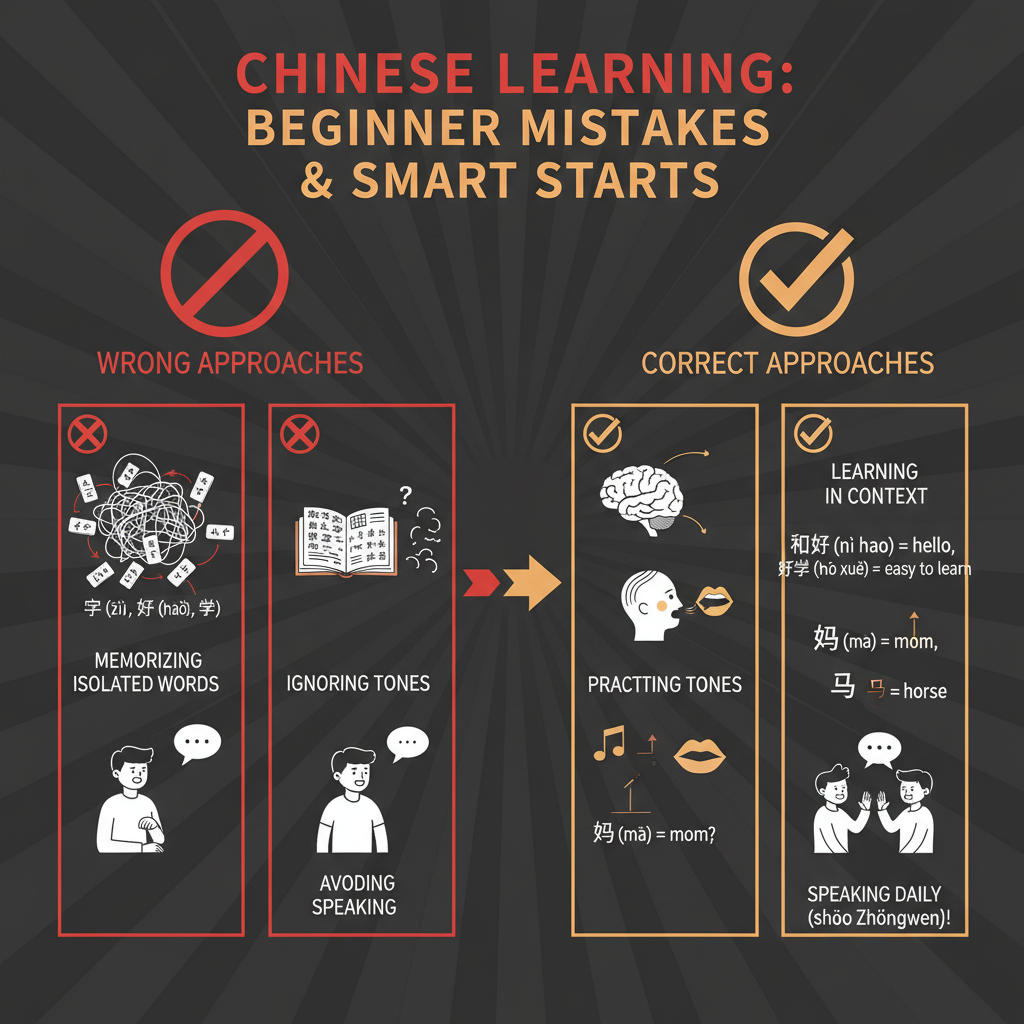
Mistake 1: Treating Tones as Optional
This is the single most damaging mistake a Chinese beginner can make, and it is disturbingly common among online learners. The reasoning goes something like this: "I will focus on vocabulary and grammar first and fix my tones later." This is like saying you will learn to drive first and add the steering wheel later.
Tones are not decoration on top of words. They are part of the words. "Ma" with a flat high tone means mother. "Ma" with a falling tone means to scold. If you learn "ma" without a tone, you have not learned a Chinese word -- you have learned a meaningless syllable.
The fix: Learn every single word with its tone from day one. When you review flashcards, if you get the word right but the tone wrong, mark it wrong. Use a learning platform that includes tone practice with audio feedback. Spend your first two weeks focused primarily on tone perception and production. Our pinyin mastery guide walks you through exactly how to build this foundation.
Mistake 2: Studying Without Speaking
Online learners are particularly susceptible to this mistake because studying silently on a computer feels productive. You are learning vocabulary, reading grammar explanations, scoring well on quizzes. Your knowledge grows on paper. But knowledge you cannot produce is passive knowledge, and passive knowledge alone will never let you have a conversation.
Speaking is a separate skill from understanding. It uses different neural pathways and requires motor skills (mouth, tongue, breath control) that reading and listening do not develop. If you study for six months without speaking, you will find yourself understanding a lot but unable to say much. This gap is demoralizing and entirely preventable.
The fix: Speak from day one. Read your flashcards out loud. Shadow audio recordings. Use AI conversation tools for daily speaking practice. Even two minutes of speaking per study session makes a measurable difference over months.

Mistake 3: App Hopping
You start with App A. After two weeks, someone recommends App B. You switch. Three weeks later, you read a review praising App C. You switch again. After two months, you have used five different apps, completed the beginning of each one multiple times, and learned the same fifty basic words over and over.
App hopping feels like progress because you are always "starting fresh" with high motivation. But real progress happens in the middle stages of a curriculum, not the beginning. By constantly restarting, you never reach the content that would actually advance your ability.
The fix: Choose one primary learning platform and commit to it for at least two months before evaluating. No platform is perfect, but any decent platform used consistently will outperform the "perfect" platform used sporadically.
Mistake 4: Memorizing Characters Without Understanding Components
Brute-force character memorization is the approach most beginners try first: stare at the character, write it ten times, move on. This works for the first fifty characters. By character 200, you are confusing similar-looking characters constantly. By 500, you are drowning.
Chinese characters are not random arrangements of strokes. They are composed of reusable components -- radicals and phonetic elements -- that provide clues about meaning and pronunciation. Learning these components turns character study from rote memorization into pattern recognition, which is far more scalable.
The fix: Learn the 50 most common radicals in your first month. When you encounter a new character, break it into components before trying to memorize it. Ask: what radical does it use? What does that radical usually mean? Does the other component give a pronunciation hint? This analysis takes seconds and dramatically improves retention.
Mistake 5: Ignoring Listening Practice
Many online learners are visual learners who gravitate toward reading, flashcards, and written exercises. Listening gets neglected because it feels less controllable -- you cannot pause real conversation, and audio moves at its own pace.
But listening is how most real-world Chinese communication happens. If you cannot understand spoken Chinese at a natural pace, your reading and vocabulary knowledge has limited practical value. And listening skills, once neglected, take a long time to catch up.
The fix: Include at least five minutes of pure listening practice in every study session. Start with slow, clear audio at your level and gradually increase speed and complexity. Listen to the same content multiple times -- repetition builds comprehension.
Pro tip: The four skills -- listening, speaking, reading, and vocabulary -- reinforce each other. Neglecting any one of them creates a bottleneck that slows progress across all of them. A balanced study routine does not need equal time on each, but it does need at least some time on each.
Mistake 6: Studying Grammar Rules Instead of Patterns
Western language education trains us to study grammar through rules and exceptions. "The past tense is formed by adding -ed to the verb, except for irregular verbs, which must be memorized." Chinese grammar does not work well with this approach because it is fundamentally different from European grammar.
Chinese grammar is better understood through sentence patterns and word order than through abstract rules. Instead of learning "the particle le indicates completed action," learn the pattern "subject + verb + le + object" with multiple concrete examples until the pattern becomes intuitive.
The fix: For every grammar point, learn three to five example sentences rather than memorizing the rule. Practice producing those sentences with different vocabulary until the pattern is automatic. Grammar rules are reference material, not study material.
Mistake 7: Setting Unrealistic Timelines
The internet is full of claims like "learn Chinese in 90 days" or "fluent in six months." These claims sell courses, not realistic expectations. The truth is that meaningful Chinese proficiency takes years, and expecting otherwise sets you up for disappointment.
This does not mean progress is slow. You can have basic conversations within three months. You can read simple texts within six months. You can handle most daily situations within a year. These are real, valuable milestones. But they are not "fluency," and confusing early progress with the endpoint causes many learners to quit when they realize how much remains.
The fix: Set milestone-based expectations, not endpoint expectations. Your goal should not be "become fluent" but "reach HSK 1 by March" or "order a meal entirely in Chinese by April." Celebrate each milestone as a genuine accomplishment, because it is.
Mistake 8: Never Testing Yourself
It is comfortable to stay in learning mode forever -- watching lessons, reading explanations, reviewing flashcards. Testing yourself is uncomfortable because it reveals gaps. But those gaps exist whether you test for them or not, and discovering them early is far better than discovering them in a real conversation.
Testing is also one of the most powerful learning techniques available. The testing effect, one of the most well-replicated findings in cognitive science, shows that retrieving information from memory strengthens the memory far more than simply reviewing it. Every time you test yourself, you are actively strengthening your knowledge.
The fix: Take an HSK practice test every four to six weeks. Do regular quizzes on recent material. Use spaced repetition, which is essentially continuous self-testing. And practice having conversations, which is the ultimate real-world test of your ability.
Mistake 9: Learning in Isolation
Online learning can be isolating. You study alone, at your own pace, with no classmates and no teacher. This independence is an advantage for flexibility, but it can become a disadvantage for accountability and motivation.
Learners who connect with other learners -- even casually through online communities -- persist longer and progress faster. Having someone to share frustrations, celebrate victories, and compare notes with adds a social dimension that pure self-study lacks.
The fix: Join an online community of Chinese learners. This does not need to be a major time commitment -- checking in with a study group weekly or sharing progress on a forum takes minutes but provides motivation that lasts days.
The Meta-Mistake: Quitting Too Early
Every mistake on this list is fixable while you are still learning. The only unfixable mistake is quitting. And most people who quit Chinese do so in the first three months, before they have given the process enough time to produce visible results. If you are just starting out, our complete beginner's guide to learning Mandarin online provides the structured path that avoids these pitfalls from the start.
The first three months are the hardest not because the material is the hardest (it is actually the easiest) but because the reward-to-effort ratio is the lowest. You are doing maximum learning for minimum visible payoff. After three months, the equation flips -- every hour of study produces more noticeable improvement than it did in month one.
"If you can get through the first three months, you will probably not quit. The difficulty is not a wall -- it is a hill. Once you get over the crest, gravity starts working in your favor."
Avoid These Mistakes from Day One
Our structured curriculum is designed to prevent every mistake in this article -- with built-in tone training, speaking practice, spaced repetition, and progress tracking to keep you on the right path.
Related Articles



Written by Conor Martin AI
Creator of the Learn Chinese for Beginners YouTube channel and the Chinese AI learning platform. Helping thousands of people start their Mandarin journey with clear, structured, no-nonsense teaching.
Enjoyed this article?