
How to Create a Chinese Learning Study Plan for Absolute Beginners (0-3 Months)
A week-by-week blueprint that turns "I want to learn Chinese" into measurable daily actions.
The biggest difference between people who learn Chinese and people who try to learn Chinese is not talent, not time, and not motivation. It is structure. People who succeed follow a plan. People who fail study randomly -- a bit of vocabulary here, a YouTube video there, maybe some flashcards when they remember -- and then wonder why nothing sticks.
This article gives you the plan. It is a week-by-week blueprint for your first three months of Mandarin Chinese, designed for absolute beginners studying online with 30 to 45 minutes per day. Every week has specific goals, specific activities, and specific milestones so you always know exactly where you should be and what you should be doing.
Before You Start: Set Your Environment
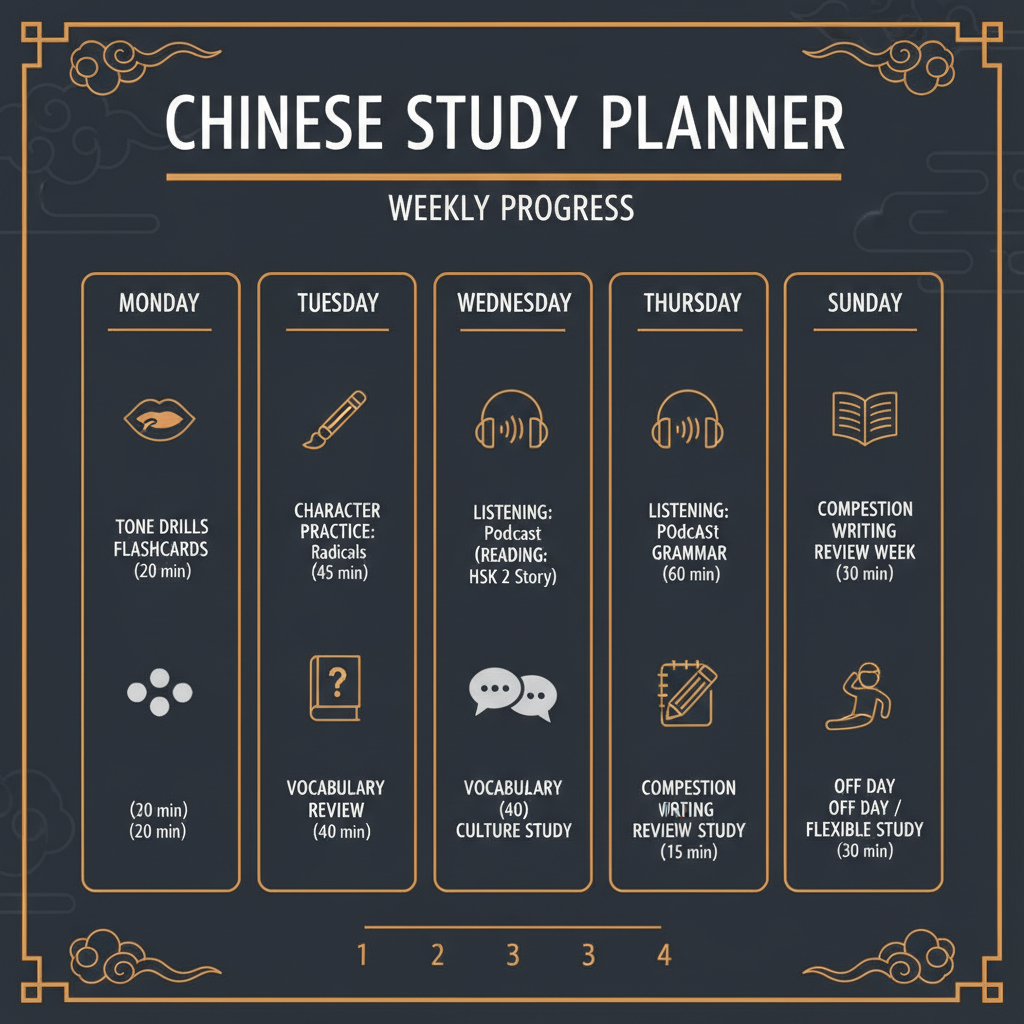
Before you study a single word, set up your environment for success. Choose one primary learning platform and commit to it for at least eight weeks. Download a spaced repetition app for vocabulary review. Set a fixed daily study time that you protect like any other appointment. Put your phone in Chinese language mode if you are feeling bold.
Prepare a notebook -- physical or digital -- for writing down new words, questions, and observations. Having a dedicated space for Chinese study, even if it is just a specific seat at your desk, creates a psychological trigger that helps your brain shift into learning mode.
Pro tip: The best study plan in the world fails without a consistent daily habit. Before worrying about what to study, lock in when and where you will study. Attach it to an existing routine -- study Chinese immediately after your morning coffee, or during your lunch break, or right before bed.
Weeks 1-2: The Pinyin Foundation
Your entire first two weeks should focus almost exclusively on pinyin and tones. This feels painfully slow when you are excited to start learning "real Chinese," but pinyin is real Chinese. It is the phonetic roadmap for every word you will ever learn. Rushing through it is like building a house on sand.
Week 1 Goals
By the end of week 1 you should be able to:
- Identify and pronounce all 21 initials with reasonable accuracy
- Identify and pronounce the most common finals (a, o, e, i, u, ai, ei, ao, ou, an, en, ang, eng)
- Produce the four tones in isolation with correct pitch contours
- Distinguish between the four tones when hearing them in isolation
- Say basic greetings: hello (nihao), thank you (xiexie), goodbye (zaijian)
Daily routine for week 1: 10 minutes on initials and finals practice with audio, 10 minutes on tone perception drills (listen and identify which tone), 10 minutes on the five to seven basic greetings and social phrases.
Week 2 Goals
By the end of week 2 you should be able to:
- Pronounce the tricky pinyin sounds: zh/ch/sh vs z/c/s, the u with umlaut, the "r" initial
- Produce tone pairs -- two tones in sequence -- with reasonable accuracy
- Understand third tone sandhi (third tone before third tone becomes second tone)
- Read any pinyin syllable with tone marks and pronounce it correctly
- Know 20-30 basic words with correct tones
Daily routine for week 2: 5 minutes reviewing initials and finals, 10 minutes on tone pair drills, 10 minutes on new vocabulary with pinyin, 10 minutes listening to and shadowing simple dialogues.

Weeks 3-4: First Words and Simple Sentences
With a solid pinyin foundation, you can now start building vocabulary and producing your first sentences. The focus shifts from pure pronunciation to communication, though you should continue refining your tones throughout.
Week 3 Goals
By the end of week 3 you should:
- Know 60-80 words covering pronouns, basic verbs, numbers 1-10, common nouns
- Be able to form simple subject-verb-object sentences
- Understand and use basic question structures (ma questions and question word questions)
- Have started learning your first 20 characters (the simplest, most common ones)
- Be able to introduce yourself: name, nationality, and one or two facts
Daily routine for week 3: 5 minutes of spaced repetition vocabulary review, 15 minutes of new lesson content (vocabulary plus grammar patterns), 10 minutes of speaking practice (AI tutor or shadowing), 5 minutes of character recognition.
Week 4 Goals
By the end of week 4 you should:
- Know 100-120 words and recognize 30-40 characters
- Be able to talk about daily routines, food preferences, and family members
- Use numbers up to 100 and basic money expressions
- Understand and produce simple time expressions (today, tomorrow, morning, evening)
- Complete a five-minute AI conversation on a familiar topic with minimal pauses
At the end of month one, take stock. You have been studying for four weeks. You should feel like you can say basic things, even if it is clumsy. You should be able to hear tones most of the time. You should have a growing recognition vocabulary. If you are behind on any of these, spend an extra few days reviewing before moving on. There is no deadline here except the one you set for yourself.
Weeks 5-8: Building the Conversation Engine
Month two is where studying starts to feel like learning. You have enough building blocks to construct real meaning, and the focus shifts toward using what you know in flexible ways rather than memorizing isolated pieces.
Weeks 5-6: Expanding Your Range
These weeks introduce more complex grammar patterns: expressing desire (want to), ability (can), possession (have), location (at/in), and description (adjective + noun). Each pattern dramatically multiplies what you can say. With "I want to go to [place]" alone, you can express hundreds of intentions.
Targets for weeks 5-6:
- Vocabulary: 180-220 words, 60-80 characters recognized
- Grammar: 10-12 sentence patterns mastered with automatic recall
- Speaking: Can sustain a basic conversation for 5-8 minutes on familiar topics
- Listening: Can understand simple sentences spoken at moderate speed
- Cultural knowledge: Basic understanding of Chinese social etiquette in conversation
Weeks 7-8: Real-World Practice
These weeks are about applying everything in more realistic scenarios. Practice ordering at a restaurant, asking for directions, making purchases, and describing your daily life. The goal is fluency within a limited domain -- you cannot talk about politics yet, but you can handle a trip to the grocery store.
Targets for weeks 7-8:
- Vocabulary: 250-300 words, 100-120 characters recognized
- Grammar: Can combine multiple patterns in a single sentence
- Speaking: Can role-play common real-world scenarios
- Listening: Can follow a simple story or dialogue with context clues
- Characters: Beginning to write simple characters, not just recognize them
Our structured curriculum follows this exact progression, with AI-powered lessons that adapt to your pace and provide instant feedback.
Weeks 9-12: Approaching HSK 1
The third month is about consolidation and expansion. You are aiming for HSK 1 level, which represents basic Chinese proficiency: roughly 150 characters, 300 words, and the ability to handle simple daily communication.
Weeks 9-10: Depth Over Breadth
Rather than cramming new vocabulary, these weeks focus on deepening your command of what you already know. Practice using your vocabulary in varied contexts. Learn to express the same idea in different ways. Fill in the gaps -- the words you keep wanting to say but do not know yet.
This is also when listening comprehension should become a priority. Start listening to beginner-level Chinese podcasts or graded content. The goal is to understand the main idea without translating word by word -- to start processing Chinese as Chinese rather than as encoded English.
Weeks 11-12: Integration and Assessment
The final two weeks are about putting it all together. Take an HSK 1 practice test to see where you stand. Have a longer conversation with an AI tutor or language partner. Write a short paragraph about yourself in characters. These activities reveal what you actually know versus what you think you know.
End of month three targets:
- Vocabulary: 350-500 words depending on study intensity
- Characters: 150-200 recognized, 50-80 writable
- Speaking: Can sustain a 10-15 minute conversation on familiar topics
- Listening: Can understand simple conversations between native speakers at moderate speed
- Grammar: Comfortable with 20+ sentence patterns covering most basic communication needs
- HSK 1 practice test: 70% or higher score
How to Adapt This Plan to Your Life
This plan assumes 30 to 45 minutes of daily study. If you have more time, spend the extra on speaking practice and listening -- these have the highest marginal returns. If you have less time, cut character writing first (you can add it later) and focus on vocabulary, listening, and speaking. For advice on calibrating your expectations, read our guide on how to set realistic Chinese learning goals.
If you miss a day, do not try to double up the next day. Just continue where you left off. If you miss a week, go back two to three days in your plan and review from there. The plan is a guide, not a contract. The only rule that is truly non-negotiable is consistency: study something every day, even if it is just five minutes of flashcard review on a bad day.
What Comes After Month Three
At the end of this plan, you will have a real foundation in Mandarin Chinese. You will not be fluent -- fluency takes years. But you will have the tools, habits, and base knowledge to continue progressing efficiently. The path from HSK 1 to HSK 3 is the next natural phase, and our Chinese learning roadmap from zero to HSK 3 covers exactly that journey.
The hardest part of learning Chinese is the first three months. It is when everything is unfamiliar, when progress feels slow, and when the temptation to quit is strongest. Having a clear plan does not make it easy, but it makes it manageable. You always know what to do next. And that clarity is often the difference between someone who learns Chinese and someone who tried to.
Follow a Proven Study Plan with AI Guidance
Our 10-week structured curriculum provides the exact daily study plan described in this article, complete with AI-powered lessons, vocabulary drills, speaking practice, and progress tracking.
Related Articles


Written by Conor Martin AI
Creator of the Learn Chinese for Beginners YouTube channel and the Chinese AI learning platform. Helping thousands of people start their Mandarin journey with clear, structured, no-nonsense teaching.
Enjoyed this article?