
Pinyin Mastery: Learning Correct Pronunciation from Day One
Pinyin looks like English but sounds nothing like it. Getting this right from the start saves you months of correction later.
Pinyin is the official romanization system for Standard Mandarin Chinese, created in the 1950s to help with literacy and language standardization. It uses the same 26 letters as English, which is both its greatest strength and its greatest trap. Because the letters look familiar, your brain automatically assigns them English sounds. And for many letters, that assignment is wrong.
The consequence of ignoring this is severe. If you learn pinyin with English pronunciation habits, you build a foundation of incorrect sounds that becomes progressively harder to fix as your vocabulary grows. Every new word learned with the wrong sound is a word you will eventually have to relearn. Getting pinyin right from day one is the single highest-return investment in your Chinese learning journey.
The Sounds That Match English (Mostly)
Some pinyin sounds are close enough to English that your existing pronunciation will work. The consonants b, p, m, f, d, t, n, l, g, k, and h are similar to their English counterparts, though not identical. B and d in pinyin are unaspirated (no puff of air), which makes them sound closer to English "b" and "d" to most ears, though technically they are voiceless unaspirated stops.
The vowel "a" in pinyin is generally an open "ah" sound, like "father." The vowel "i" after most consonants sounds like "ee" in "see." The vowel "u" after most consonants sounds like "oo" in "moon." These are close enough approximations to start with, though you will refine them over time.
The Dangerous False Friends
Here is where pinyin diverges from English in ways that trip up virtually every beginner. These are the sounds you must actively retrain yourself on.
C, Z, and S vs Ch, Zh, and Sh
Pinyin has two sets of sibilant consonants that English speakers typically collapse into one. The "flat" set (z, c, s) is produced with the tongue tip behind the lower teeth. The "curled" set (zh, ch, sh, r) is produced with the tongue tip curled back toward the roof of the mouth (retroflexed). English does not make this distinction, so your brain will initially treat them as the same sounds.
The letter "c" in pinyin is not a "k" sound. It sounds like the "ts" in "cats" but aspirated -- a sharp "ts" with a puff of air. "Z" sounds like the "ds" in "adds" but without voicing. These are among the most commonly mispronounced sounds by English speakers.
Q, X, and J
These three consonants have no close English equivalents. "J" in pinyin is not the "j" in "judge." It is closer to a "j" sound made with the middle of the tongue pressed against the hard palate, almost like a softer version of the "g" in "gene" but further forward in the mouth. "Q" is the aspirated version of "j" -- similar to "ch" in "cheese" but again, further forward. "X" is like "sh" in "she" but with the tongue positioned closer to the teeth.
Pro tip: The j/q/x series is the single biggest pronunciation challenge for English speakers learning pinyin. Do not rush past these sounds. Spend extra time listening to native speakers produce them and comparing against your own attempts. Getting these right marks the difference between an accent that native speakers can work with and one that causes confusion.
The Two "U" Sounds
Pinyin has a regular "u" (like "oo" in "moon") and a special "u" with an umlaut written as "u" (sometimes shown as "v" in digital input). The umlauted u sounds like the French "u" or German "u" -- you make an "ee" shape with your lips but round them into an "oo" position. This sound appears after j, q, x, and l/n in certain combinations.
The tricky part is that after j, q, and x, the umlaut is dropped in standard pinyin writing. So "ju" is actually pronounced "jv" -- with the umlauted u, not the regular u. This is a convention that textbooks explain once and learners immediately forget, leading to months of incorrect pronunciation.
Vowel Combinations That Break English Rules
Pinyin vowel combinations (finals) follow their own rules. The Chinese Grammar Wiki is an excellent reference for looking up detailed explanations of pinyin finals and grammar. Some key ones to learn:
Critical pinyin finals that differ from English expectations:
- "ou" sounds like "oh" not "ow." Think "go" not "cow."
- "iu" is actually "iou" compressed -- it sounds like "yo" as in "yo-yo."
- "ui" is actually "uei" compressed -- it sounds closer to "way."
- "ian" sounds like "yen" not "ee-ann." The "a" shifts to an "e" sound.
- "un" is actually "uen" -- it has a hidden "e" that textbooks sometimes omit.
- "e" alone is not the "e" in "bed." It is a back, unrounded vowel, like the "u" in "duh" but more open.
- "ei" sounds like "ay" in "day."
- "ao" sounds like "ow" in "how."

The Learning Sequence That Works
Do not try to learn all of pinyin in one sitting. A more effective approach sequences the sounds from most familiar to least familiar, building your confidence and ear progressively.
Recommended pinyin learning sequence:
- Week 1: The four tones with simple syllables (a, o, e, i, u). Focus entirely on pitch before adding complex consonants. Our complete guide to Mandarin tones pairs perfectly with this phase.
- Week 2: Familiar consonants (b, p, m, f, d, t, n, l) combined with simple finals. Practice tone pairs.
- Week 3: The retroflex set (zh, ch, sh, r) and flat set (z, c, s). Focus on the distinction between them.
- Week 4: The palatal set (j, q, x) and the umlauted u. These need the most attention and practice.
- Week 5: Complex finals and vowel combinations. Practice all finals with consonants you already know.
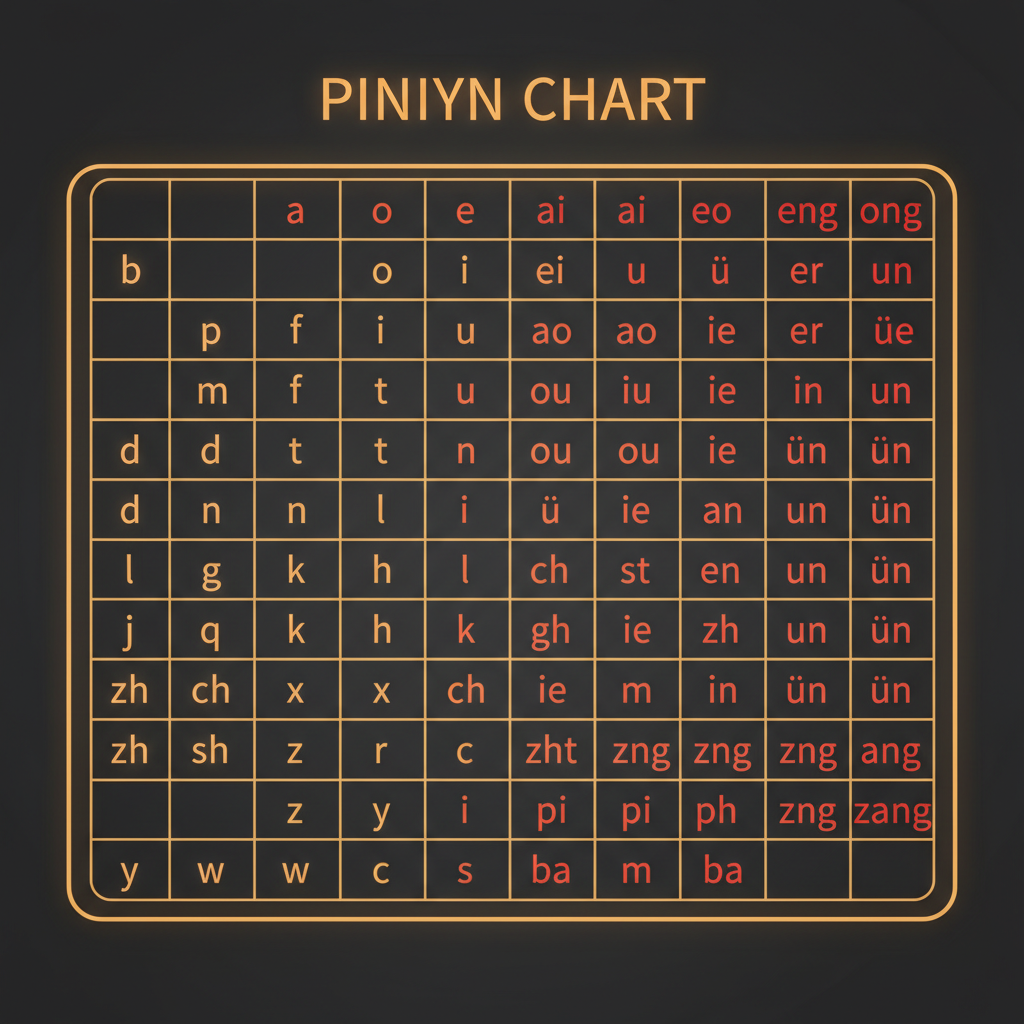
- Week 6: Review and consolidation. Record yourself reading a pinyin chart and compare to native audio.
Common Mistakes and How to Fix Them
The most common pinyin pronunciation errors and their fixes:
- Reading "c" as "k" -- Practice "cats" without the "at" and add aspiration
- Making zh/ch/sh identical to z/c/s -- Curl your tongue back for zh/ch/sh; keep it flat for z/c/s
- Pronouncing "r" like English "r" -- Mandarin "r" is closer to a French "j" sound, produced with the tongue curled back
- Treating "e" like English "e" -- Mandarin standalone "e" is a back vowel, more like "uh" than "eh"
- Ignoring the umlauted u after j/q/x -- Always use the French "u" sound after these consonants
- Adding English stress patterns -- Mandarin syllables are roughly equal in stress; do not emphasize one syllable over another within a word
When to Move Past Pinyin
Pinyin is a tool, not a destination. Once you can reliably produce all pinyin sounds with correct tones, you should progressively reduce your dependence on pinyin and read characters directly. Continued heavy reliance on pinyin past the first few months can actually slow your reading development because your brain routes through the romanization instead of directly from character to meaning.
The goal is to use pinyin as training wheels. Learn the sounds thoroughly, then gradually remove the pinyin and let the characters carry the pronunciation information in your memory. Most learners should aim to be reading primarily from characters (with occasional pinyin lookup for new words) by month four or five.
Master Pinyin with Guided Lessons
Our first two weeks are dedicated entirely to pinyin mastery, with AI pronunciation scoring that catches the subtle errors English speakers make before they become habits.
Related Articles

Complete Guide to Mandarin Tones for English Speakers (With Audio Examples)

Common Mistakes Beginners Make When Learning Chinese Online (And How to Avoid Them)

How to Fix Your Chinese Pronunciation If You Have Been Learning Incorrectly
Written by Conor Martin AI
Creator of the Learn Chinese for Beginners YouTube channel and the Chinese AI learning platform. Helping thousands of people start their Mandarin journey with clear, structured, no-nonsense teaching.
Enjoyed this article?