Best Apps and Tools for Chinese Tone Practice with Instant Feedback
An honest review of the tone practice tools available in 2025 -- what works, what does not, and what is worth paying for.
The tone practice tool market has exploded. Every Chinese learning app now claims some form of pronunciation feedback. But the quality varies enormously. Some tools provide genuinely useful, specific feedback that accelerates your learning. Others provide vague "good/bad" scores that feel like feedback but do not actually help you improve.
The difference matters. A tool that tells you "your tone was incorrect" teaches you nothing. A tool that tells you "your second tone started rising too late and did not reach a high enough pitch" teaches you exactly what to fix. For a broader look at practice methods you can pair with these tools, see our guide on how to practice tones online without a tutor. Here is how to evaluate what is available and where to invest your time and money.
What Makes a Tone Practice Tool Effective
Before reviewing specific tools, it is worth understanding what features actually matter for tone improvement. Not all feedback is created equal.
Features that matter for tone practice tools:
- Pitch contour visualization: Shows your actual pitch as a line graph compared to the target. This is the gold standard for feedback specificity.
- Tone-specific scoring: Tells you which tone was wrong, not just that "something was off" in a phrase.
- Minimal pair drills: Forces you to distinguish between confusable tones with immediate right/wrong feedback.
- Progress tracking: Shows your accuracy trends over time so you can see improvement and identify persistent weak spots.
- Spaced repetition for problem tones: Automatically schedules more practice for your weakest tone combinations.
- Native audio comparison: Lets you play your recording side-by-side with a native speaker for direct comparison.
Features that sound useful but matter less than you think:
- Gamification (points, streaks, badges): Fun but does not improve feedback quality. You can have perfect streaks while producing incorrect tones.
- Speech-to-text accuracy: If the tool can transcribe what you said, it means the tones were close enough for a machine -- but "close enough for a machine" is a much lower bar than "natural to a human ear."
- Social features (compare with friends): Community is motivating but does not improve your actual tone production.
Category 1: AI Pronunciation Platforms
These are dedicated platforms that use AI to analyze your speech and provide detailed pronunciation feedback. They represent the most effective category of tone practice tools because they combine perception training with production feedback.
The best platforms in this category analyze your pitch contour at the syllable level, show you a visual comparison against native models, and provide specific corrective suggestions. Some also integrate tone practice into broader curriculum structures so you are practicing tones within meaningful vocabulary rather than as isolated exercises.
Pro tip: When evaluating AI pronunciation platforms, test them with deliberately wrong tones. If the platform marks clearly incorrect tones as correct, its feedback engine is not reliable enough to trust. A good platform should catch obvious errors consistently.
Category 2: Pitch Visualization Tools
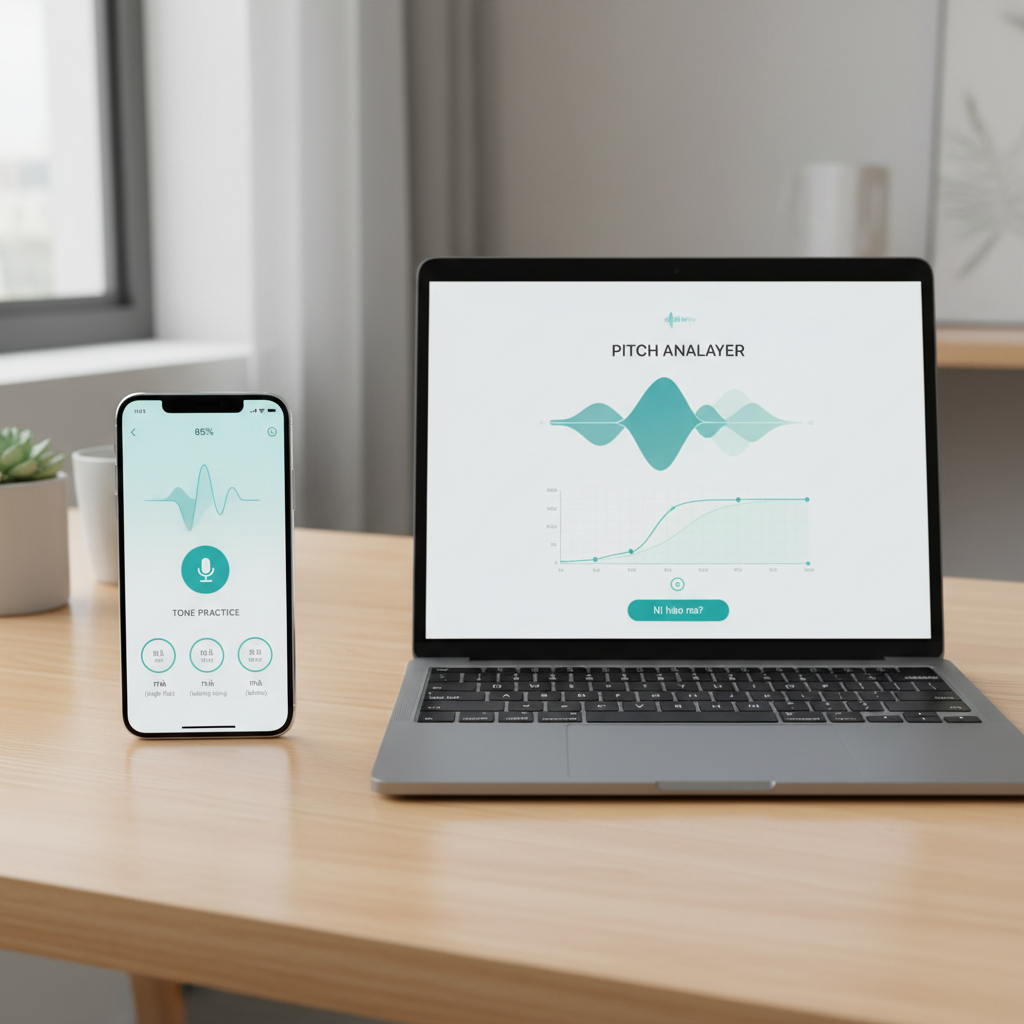
These tools record your voice and display the pitch as a visual graph. They do not necessarily score your tones, but they show you exactly what your voice is doing. This is valuable because it exposes discrepancies between what you think you are saying and what you are actually producing.
The limitation of visualization-only tools is that they require you to interpret the graphs yourself. You need to know what a correct tone looks like to evaluate whether your graph matches. For beginners, this can be confusing. For intermediate learners who already understand the tone system, visual tools are extremely powerful for self-correction.
Category 3: Perception Training Tools
These tools focus entirely on listening. They play tones and ask you to identify them -- minimal pair drills, tone identification quizzes, dictation exercises. They do not train your speaking at all, but they build the perceptual foundation that accurate speaking requires.
Perception tools are most valuable in your first two to four weeks of tone study. After that, you should be combining perception with production practice. But if your perception is weak -- if you struggle to hear the difference between second and third tone -- then production practice is premature. Fix your ears first.
Category 4: General Chinese Learning Apps with Tone Features
Most popular Chinese learning apps include some form of pronunciation practice, but it is rarely their core strength. The tone feedback in general-purpose apps tends to be less specific and less accurate than in dedicated pronunciation tools. It is better than nothing, but if tones are a priority (and they should be), supplement with a dedicated tool.

Free vs Paid: Where to Invest
Free tools can handle basic perception training adequately. Minimal pair drills and tone identification exercises do not require sophisticated technology, and several free options provide competent versions of these.
Paid tools are worth the investment for production feedback -- the AI pronunciation analysis, pitch visualization, and specific corrective guidance. The technology behind accurate speech analysis is expensive to build and maintain, and this is reflected in the quality gap between free and paid offerings.
A reasonable approach: use free perception tools for the first month while you build your listening foundation, then invest in a paid platform with production feedback once you start focusing on speaking accuracy.
The Tool Matters Less Than the Routine
The honest truth is that any decent tool used daily for 10 to 15 minutes will produce better results than the best tool used sporadically. Consistency is the dominant variable in tone improvement, not tool quality. A mediocre app used every day beats a premium platform used twice a week.
Choose a tool that fits your workflow, provides feedback specific enough to guide improvement, and does not require so much friction that you avoid opening it. Then use it every single day. The results will follow.
AI Tone Practice Built Into Every Lesson
Our platform integrates tone practice directly into your daily curriculum -- no need to switch between apps. Every new word gets pronunciation feedback, and weekly tone reviews target your specific weak spots.
Related Articles

How to Practice Chinese Tones Online Without a Tutor (5 Proven Methods)
Essential Chinese Learning Tools Every Beginner Needs (Free and Paid Breakdown)
Chinese Tone Drills: 15-Minute Daily Practice Routine for Tone Accuracy
Written by Conor Martin AI
Creator of the Learn Chinese for Beginners YouTube channel and the Chinese AI learning platform. Helping thousands of people start their Mandarin journey with clear, structured, no-nonsense teaching.
Enjoyed this article?