
Understanding HSK Levels: Which One Should You Start With?
A clear breakdown of every HSK level, what each one means in practical terms, and how to use them as learning milestones.
If you have researched learning Chinese for more than ten minutes, you have encountered the HSK. It stands for Hanyu Shuiping Kaoshi, which translates to "Chinese Proficiency Test." It is administered by the Chinese government through the official HSK website and recognized worldwide by universities, employers, and immigration authorities.
But the HSK is more than a test. For self-study learners, HSK levels serve as the most practical framework for understanding where you are, where you are going, and what you need to learn next. Even if you never sit for the actual exam, understanding the levels gives your study direction and measurable milestones.
The HSK Structure at a Glance
The current HSK system has six levels, from HSK 1 (complete beginner) to HSK 6 (advanced). A revised system with nine levels has been announced but adoption has been gradual. For now, the six-level system remains the standard reference for most learners and institutions.
Each level defines a specific vocabulary count, character count, grammar scope, and set of communication abilities. The levels are cumulative -- HSK 3 includes everything from HSK 1 and 2 plus new material.
HSK 1: The First Step
Vocabulary: approximately 150 words. Characters: approximately 174. Grammar: basic sentence structures, simple questions, negation.
In practical terms, HSK 1 means you can handle very basic interactions. You can introduce yourself, order food, ask simple questions, understand slow and clear speech on familiar topics, and read very short, simple texts with familiar vocabulary.
Most committed beginners studying 30 minutes daily reach HSK 1 level in two to three months. This is the first major milestone and it proves that yes, you can learn Chinese. The psychological value of reaching HSK 1 should not be underestimated.
Pro tip: HSK 1 is the right starting target for absolute beginners. It is achievable, concrete, and gives you enough Chinese to have basic real-world interactions. Do not skip ahead to targeting HSK 2 or 3 before you have solidly achieved this level.
HSK 2: Functional Basics
Vocabulary: approximately 300 words. Characters: approximately 347. Grammar: comparison structures, aspect markers, more complex questions.
HSK 2 represents basic functional ability. You can handle routine tasks -- shopping, transportation, simple conversations about daily life. You can understand sentences and frequently used expressions related to areas of most immediate relevance: personal information, shopping, local geography, employment basics.
The jump from HSK 1 to HSK 2 typically takes another two to three months. The grammar becomes more interesting at this level, introducing concepts like expressing changes of state, comparing things, and talking about past and future events with more precision.
HSK 3: The Conversational Threshold
Vocabulary: approximately 600 words. Characters: approximately 617. Grammar: complex sentences, conditional structures, expressing opinions.
HSK 3 is where Chinese starts to feel like a real language you can use rather than a collection of phrases you have memorized. You can handle most situations that arise while traveling in China. You can describe experiences, events, and ambitions. You can give reasons and explanations for opinions and plans. Our roadmap from zero to HSK 3 lays out the full journey to reach this level.
Many Chinese language programs at universities require HSK 3 for admission to study-abroad programs. It is also the level many employers consider the minimum for "basic Chinese ability" on a resume. Reaching HSK 3 typically takes 8 to 12 months of consistent study.

HSK 4: Intermediate Fluency
Vocabulary: approximately 1,200 words. Characters: approximately 1,064. Grammar: formal and informal registers, abstract expression, paragraph-level discourse.
HSK 4 is often described as the point where you can "survive" entirely in Chinese. You can follow and participate in conversations on a wide range of topics. You can read articles and opinion pieces with the help of a dictionary. You can express yourself fluently enough that communication rarely breaks down.
This level typically requires 1.5 to 2 years of consistent study. The vocabulary doubles from HSK 3, and the grammar introduces many of the structures needed for natural-sounding Chinese. Many learners find HSK 4 to be the most satisfying level because it represents genuine communicative independence.
HSK 5 and 6: Advanced Territory
HSK 5 (approximately 2,500 words) represents advanced fluency -- you can read Chinese newspapers, understand Chinese TV shows, and participate in professional discussions. HSK 6 (approximately 5,000 words) represents near-native reading ability and the capacity to express yourself precisely on any topic.
These levels are aspirational for most casual learners and practical requirements for people pursuing careers in Chinese translation, academia, or senior business roles in China. Reaching HSK 5 typically takes 3 to 4 years; HSK 6 can take 5 or more years.
Using HSK Levels Without Taking the Test
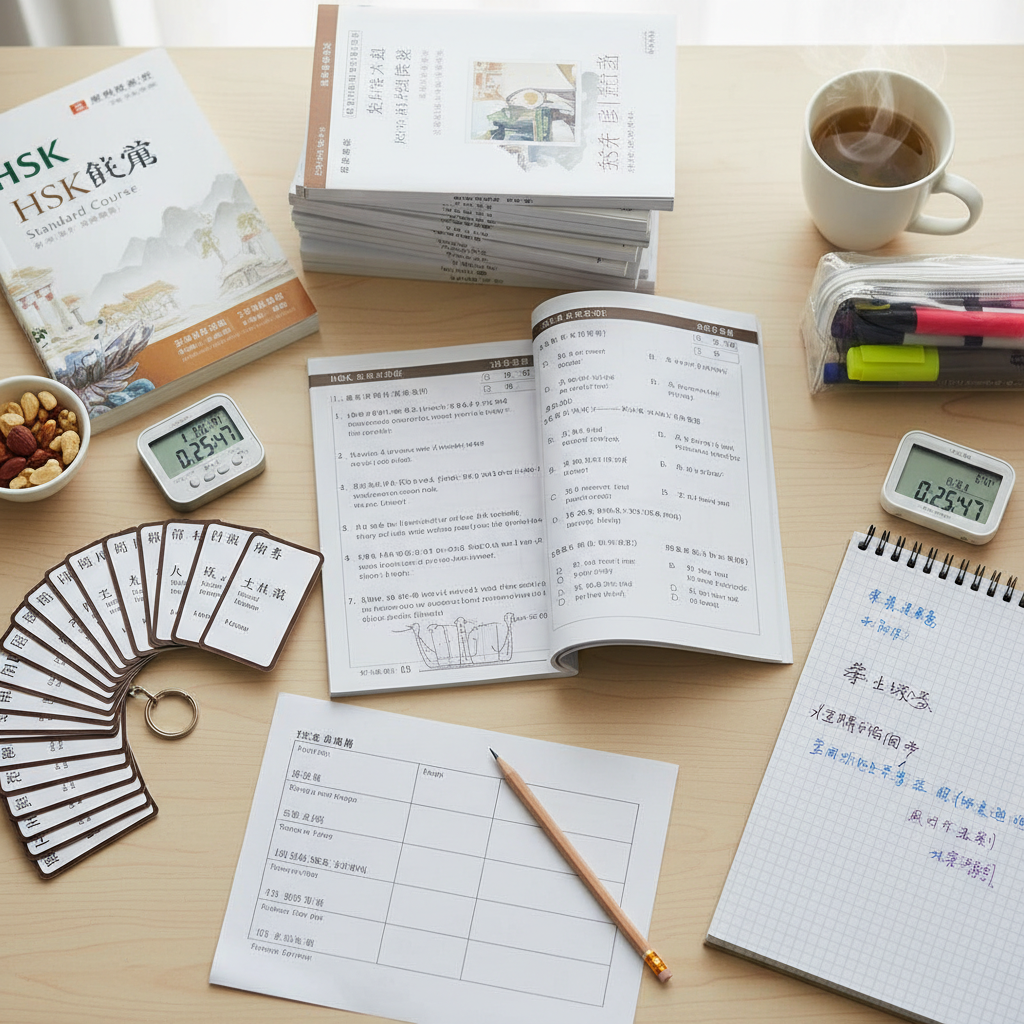
You do not need to take the HSK exam to benefit from the level framework. HSK vocabulary lists give you clear targets for what words to learn. HSK grammar lists tell you what structures to master at each stage. HSK practice tests let you assess your own progress without paying for or traveling to an exam.
How to use HSK levels as a self-study framework:
- Set your current target level based on your timeline and goals
- Use the vocabulary list for that level as your study list -- learn these words before any others
- Use HSK practice tests every four to six weeks to measure progress objectively
- When you consistently score above 70 percent on practice tests, you have reached that level
- Move to the next level and repeat the process
When You Should Actually Take the Test
Take the HSK if you need it for a specific purpose: university admission, visa applications, job requirements, or scholarship applications. Also consider taking it if you need external motivation -- having a test date creates accountability that self-study alone does not provide.
The test is offered multiple times per year at test centers worldwide and can also be taken online. Registration fees are modest. The test itself is standardized and fair -- if you can consistently pass practice tests, you will pass the real thing.
Where to Start
If you are reading this article, you should target HSK 1. It is the right goal for someone just beginning their Chinese journey. It is specific enough to study toward, achievable enough to reach within months, and meaningful enough to feel like a real accomplishment. When you are ready to prepare, our guide to the best online HSK course for self-study can help you choose the right resources.
Do not worry about HSK 6 right now. Do not even think about HSK 3. Focus on the next level, achieve it, celebrate briefly, and then focus on the one after that. The entire journey from HSK 1 to HSK 6 is built one level at a time, and it starts with the 150 words and basic sentence structures of level one.
Start Working Toward HSK 1 Today
Our curriculum is aligned with HSK standards, taking you from zero to HSK 1 readiness in the first 10 weeks with structured lessons and vocabulary tracking.
Related Articles


Written by Conor Martin AI
Creator of the Learn Chinese for Beginners YouTube channel and the Chinese AI learning platform. Helping thousands of people start their Mandarin journey with clear, structured, no-nonsense teaching.
Enjoyed this article?