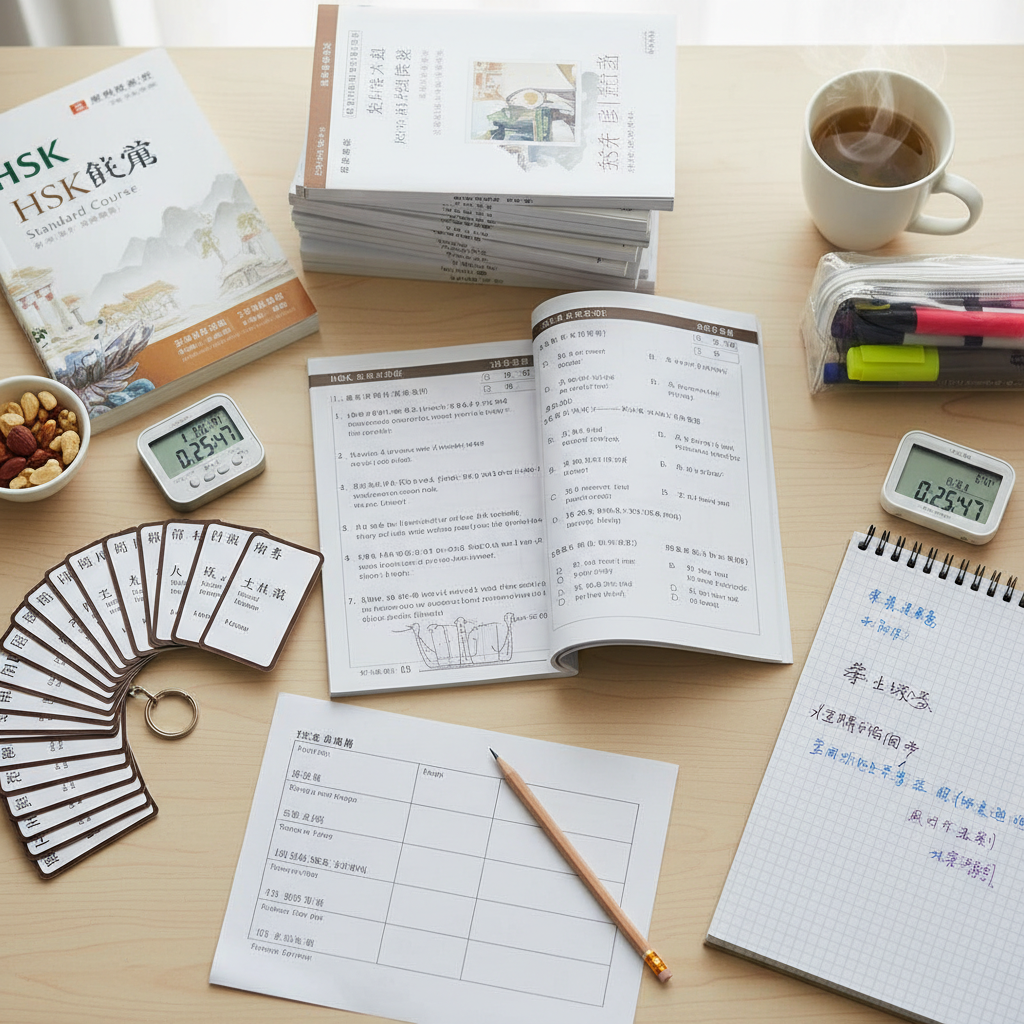
Best Online HSK Course for Self-Study from HSK 1 to HSK 4
The HSK is the global standard for Chinese proficiency. Whether you are studying for career advancement, academic entry, or personal benchmarking, here is how to prepare effectively through self-study.
The HSK (Hanyu Shuiping Kaoshi) is the standardized Chinese proficiency test recognized worldwide by universities, employers, and immigration authorities. Passing HSK levels demonstrates concrete Chinese ability in a way that "I have been studying for two years" does not. If you are unsure which level to target first, read our guide on understanding HSK levels and which one to start with. Whether you need HSK for practical reasons or simply want objective benchmarks for your progress, preparing for the exam gives your study direction, deadlines, and measurable outcomes.
The good news is that HSK 1 through 4 are entirely achievable through self-study. You do not need a classroom, a teacher, or an expensive prep program. You need a clear understanding of what each level tests, the right resources, and a disciplined study plan. The bad news is that most "HSK prep courses" are glorified vocabulary lists with practice tests stapled on. They teach you to pass the test in the narrowest sense without building the underlying Chinese ability that makes passing natural rather than stressful.
This article gives you a level-by-level breakdown of HSK 1 through 4, evaluates the types of courses available for each, and provides a study framework that builds real Chinese ability and HSK readiness simultaneously.
Understanding What the HSK Actually Tests
Before choosing a course, you need to understand the test format. Many self-study learners prepare based on misconceptions about what HSK requires, leading to frustrating gaps between their ability and the test demands.
HSK level overview:
- HSK 1: 150 words, 174 characters. Tests basic listening and reading comprehension. Simple sentences about daily life. No writing section. Pass score: 120/200.
- HSK 2: 300 words, 347 characters. Tests listening and reading at a slightly higher level. Can discuss routine daily matters. No writing section. Pass score: 120/200.
- HSK 3: 600 words, 617 characters. Tests listening, reading, and writing. Can communicate in daily, academic, and professional situations at a basic level. Writing involves sentence construction from given words. Pass score: 180/300.
- HSK 4: 1,200 words, 1,064 characters. Tests listening, reading, and writing. Can discuss a wide range of topics with relative fluency. Writing involves short compositions. Pass score: 180/300.
A critical detail that many learners miss: the HSK tests receptive skills (listening and reading) much more heavily than productive skills (writing, and no speaking at all until HSK 5+). This means that a learner who can recognize and understand 1,200 words but can only produce 600 can still pass HSK 4. This shapes the preparation strategy significantly -- you need deep recognition of the full word list but only need production ability for a subset.
Pro tip: The new HSK (HSK 3.0) was announced in 2021 with a revised structure and expanded word lists. However, as of 2025, the transition is still ongoing and many test centers continue to offer the traditional HSK format described above. Check your specific test center or the official HSK website to confirm which version they administer before preparing. This article covers the traditional HSK format, which remains the most commonly tested.
HSK 1-2: Foundation Levels
HSK 1 and 2 are achievable by almost any learner who has studied consistently for two to four months. The vocabulary is limited to high-frequency everyday words, the grammar is restricted to the most basic patterns, and the test format relies on simple matching, multiple choice, and true/false questions.
What You Need for HSK 1-2
The official HSK vocabulary lists for levels 1 and 2 should be memorized completely, not approximately. At only 150 and 300 words respectively, these lists are small enough to master through dedicated spaced repetition in two to four weeks. Every word should be recognizable by ear (listening section), recognizable as a character (reading section), and connected to its meaning instantly without translation delay.
For listening preparation, the critical skill is not vocabulary knowledge -- you will know every word on the test. The challenge is processing speed. The audio plays once and moves on. If you need three seconds to recall that "yiyuan" means "hospital," you will miss the next sentence while your brain is still processing. Speed of recognition is everything at HSK 1-2.
The best preparation for listening speed is extensive listening practice at the test speed with test-format questions. Free HSK practice test audio is available from multiple sources online. Listen to each practice test multiple times: first for overall comprehension, then for specific weak words, then at 1.25x speed to build a processing buffer.
Recommended Study Plan for HSK 1-2
Self-study timeline (assuming 30-45 minutes daily):
- Weeks 1-3: Learn all HSK 1 vocabulary through spaced repetition. Focus on character recognition and listening recognition simultaneously.
- Weeks 4-5: Practice HSK 1 format questions. Take three to four full practice tests. Identify weak areas and target them.
- Weeks 6-9: Learn HSK 2 vocabulary while maintaining HSK 1 review. Begin reading simple sentences in characters without pinyin support.
- Weeks 10-11: Practice HSK 2 format questions. Take three to four full practice tests at timed pace.
- Week 12: Final review and test day. Focus on weak areas identified in practice tests.
HSK 3: The Turning Point
HSK 3 is where the test becomes genuinely challenging for self-study learners. The word count doubles from HSK 2, a writing section is added, and the listening passages become longer and more complex. More importantly, HSK 3 grammar patterns include structures that are fundamentally different from English and cannot be mastered through vocabulary memorization alone.
The grammar points that trip up HSK 3 candidates most frequently include: resultative complements ("ting dong le" -- heard and understood), the "ba" construction for emphasizing the object of an action, using "de" as a structural particle in complex descriptions, and expressing duration and frequency with specific word order patterns that differ from English.
A pure vocabulary-and-practice-test approach that works for HSK 1-2 is insufficient for HSK 3. You need grammar instruction, not just grammar exposure. You need to understand why Chinese sentences are constructed the way they are, not just recognize patterns from repeated practice tests.
The Writing Section Challenge
HSK 3 writing requires you to construct sentences from given words. This sounds simple but tests a skill that most app-based learners have never developed: the ability to produce grammatically correct Chinese from components rather than selecting from options. The sentence construction questions require you to know word order rules, proper use of particles, and how Chinese sentences flow logically.
The best preparation for HSK 3 writing is daily sentence production practice. Take five random HSK 3 vocabulary words each day and construct three to five original sentences using them. Check your sentences against grammar references. This practice builds the productive grammar ability that the writing section tests.

HSK 4: Real Intermediate Chinese
HSK 4 represents genuine intermediate Chinese proficiency. Passing it means you can discuss a broad range of topics, understand extended spoken passages, read multi-paragraph texts, and write short compositions. It is the level most commonly required by Chinese universities for undergraduate enrollment (often with a score of 210 or higher rather than the minimum pass of 180).
The jump from HSK 3 to HSK 4 is the largest difficulty increase in the HSK system below level 6. The vocabulary doubles again to 1,200 words. Listening passages are longer, faster, and more complex. Reading passages include implied meaning that requires inference, not just comprehension. The writing section requires short compositions rather than single sentences.
What Makes HSK 4 Hard for Self-Study Learners
Three aspects of HSK 4 are particularly challenging without a teacher or structured course.
First, the listening section uses near-natural speech speed with conversations that include topic changes, indirect answers, and implied meaning. The question might be about what the speaker will do next, requiring you to infer from context rather than extract from explicit statements. This tests listening comprehension at a depth that vocabulary knowledge alone cannot provide.
Second, the reading section includes passages with abstract or opinion-based content. You need to identify main ideas, understand the author's attitude, and make logical inferences. These skills require extensive reading practice with Chinese text at the HSK 4 level, not just vocabulary memorization.
Third, the writing section requires producing coherent short texts -- typically 80 to 100 characters about a given topic or based on provided images. This requires not just vocabulary and grammar knowledge but the ability to organize ideas in Chinese, connect sentences logically, and express opinions with supporting details.
HSK 4 Preparation Strategy
Daily study plan for HSK 4 preparation (60 minutes):
- Vocabulary review and new words (15 minutes): Spaced repetition for the full HSK 4 word list. Focus on words in context -- example sentences, not isolated translations.
- Listening practice (15 minutes): HSK 4 format listening exercises. Practice note-taking while listening. Work on inference skills by pausing audio and predicting what comes next.
- Reading practice (15 minutes): Read one HSK 4 level passage and answer comprehension questions. Focus on identifying main ideas and inferring meaning from context rather than translating word by word.
- Writing practice (15 minutes): Write one short composition of 80-100 characters on a random topic. Use only known vocabulary and grammar. Review against a grammar reference.
Evaluating HSK Prep Courses
The HSK prep course market ranges from free vocabulary lists to comprehensive programs costing hundreds of dollars. Here is how to evaluate them.
What a good HSK course provides:
- Complete vocabulary coverage organized by level, with audio pronunciation for every word and contextual example sentences
- Grammar instruction for every grammar point tested at each level, with clear explanations and multiple examples
- Practice tests that accurately replicate the real test format, timing, and difficulty
- Listening practice with authentic test-speed audio, not slowed-down learner recordings
- Writing practice with model answers that demonstrate expected quality and structure
- Progress tracking that shows readiness for test day based on practice test performance
Red flags in HSK prep courses:
- Vocabulary lists without audio or example sentences -- memorizing translations does not prepare you for listening or reading
- No practice tests or only one or two -- you need at least four to five full practice tests per level to build test familiarity
- Generic grammar explanations not tied to HSK-specific patterns -- efficient prep targets exactly what the test evaluates
- No writing practice component for HSK 3 and above -- writing is a scored section and must be practiced
- Claims of "pass guaranteed in 30 days" -- realistic HSK 4 preparation from HSK 3 level takes three to six months of consistent study
HSK Preparation vs. Real Chinese Ability
I want to address an important nuance: HSK preparation and Chinese learning are overlapping but not identical goals. Studying only for the test produces test-passing ability that may not translate to real-world communication. Studying only for real-world ability may leave gaps in test-specific skills like timed reading and structured writing.
The ideal approach integrates both. Use a structured Chinese learning platform as your primary study method -- this builds genuine language ability across all skills. Then, four to six weeks before your test date, add HSK-specific practice: vocabulary list review to fill any gaps, practice tests for format familiarity, and timed exercises to build test-day speed.
"The learner who can have a 15-minute conversation about daily life will pass HSK 3 comfortably. The learner who has memorized the HSK 3 vocabulary list but never had a conversation might pass the test but cannot use the language. Build the ability first. The test score follows."
Build Real Chinese Ability That Makes HSK Easy
Our 10-week curriculum builds the listening, speaking, reading, and vocabulary skills that underlie HSK success. When test day comes, you are not cramming word lists. You are demonstrating ability you already have.
Related Articles



Written by Conor Martin AI
Creator of the Learn Chinese for Beginners YouTube channel and the Chinese AI learning platform. Helping thousands of people start their Mandarin journey with clear, structured, no-nonsense teaching.
Enjoyed this article?