Shadowing Technique: Improving Chinese Pronunciation Through Imitation
The shadowing method bypasses your conscious mind and trains pronunciation through your brain's natural imitation circuitry.
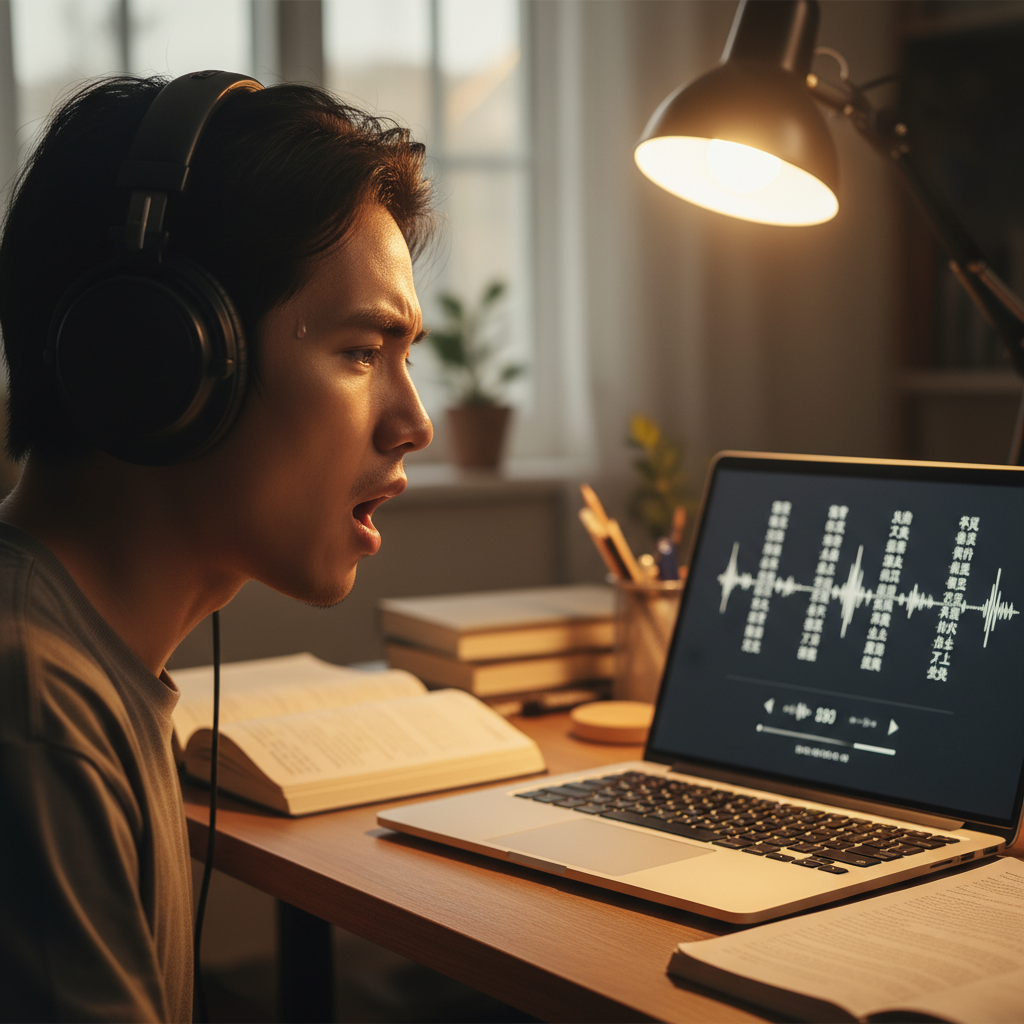
Shadowing is deceptively simple to describe: play Chinese audio and repeat what you hear in real time, matching the speaker as closely as possible. You speak simultaneously with the recording, not after it. Your voice overlaps with theirs.
This technique was developed by interpreter trainers and later adopted by language learners worldwide. It works because it engages your brain's mirror neuron system -- the same neural circuitry that allows infants to acquire pronunciation by imitating their parents. When you shadow, you bypass the analytical part of your brain that tries to "think about" tones and pronunciation, and instead engage the instinctive imitation system that acquired your native language effortlessly.
Why Shadowing Works for Chinese Specifically
Chinese pronunciation has two features that make shadowing especially valuable. First, tones require precise pitch control that is difficult to produce consciously but relatively easy to produce through imitation. When you try to "think" about making a second tone, you engage your analytical brain, which processes pitch as emotional information. When you imitate a second tone in real time, you bypass that interference.
Second, Chinese rhythm and prosody are very different from English. English is a stress-timed language where some syllables are long and loud while others are short and quiet. Mandarin is closer to syllable-timed, where each syllable gets roughly equal time and stress. Shadowing naturally trains you into Chinese rhythm patterns because you must match the native speaker's timing to stay synchronized.
The Three Stages of Effective Shadowing
Stage 1: Listening Only
Before you shadow a piece of audio, listen to it two to three times without speaking. Focus on the overall shape of the sentences -- where the pitch goes high, where it goes low, where there are pauses, where the speed changes. You are building a mental model of the audio that your voice will then try to replicate.
Stage 2: Mumble Shadowing
On your next listen, mumble along with the audio. Do not try to pronounce every syllable clearly. Instead, match the pitch contour and rhythm while letting the consonants and vowels blur. This sounds strange, but it isolates the prosodic features (pitch, rhythm, stress) from the segmental features (individual sounds), letting you train them separately.
Mumble shadowing is particularly effective for tone training because it forces you to track pitch patterns without the distraction of trying to produce correct consonants and vowels simultaneously.
Stage 3: Full Shadowing
Now speak clearly along with the audio, matching pronunciation, tones, rhythm, and speed as precisely as possible. If you lose sync, do not stop and restart. Keep going and catch up. The goal is continuous, flowing imitation, not word-by-word perfection.
Pro tip: Record your full shadowing attempt and play it back without the original audio. For a detailed approach to using recordings as a diagnostic tool, see our guide on recording yourself speaking Chinese for self-assessment. Listen for places where your tones drift, your rhythm breaks, or your pronunciation diverges. These are your specific improvement targets for the next session.
Choosing the Right Material
Material selection makes or breaks your shadowing practice. Too easy and you are not challenged. Too hard and you cannot keep up, which means you are just producing noise rather than accurate imitation.
Guidelines for selecting shadowing material:
- You should understand at least 80 percent of the vocabulary. Shadowing unfamiliar words produces sounds without meaning, which limits learning.
- The speed should be slightly faster than your comfortable speaking pace -- challenging but not impossible to follow.
- Use single speakers with clear pronunciation. Conversations between multiple speakers are too chaotic for shadowing practice.
- Start with sentences of 5-10 syllables. Longer sentences are more realistic but harder to track.
- Graded podcast episodes and textbook audio at your current level are ideal starting materials.
- As you improve, progress to native-speed podcasts, news broadcasts, and eventually movie dialogue. Our guide to Chinese listening practice with transcripts can help you find level-appropriate material.
Common Shadowing Mistakes
Errors that reduce the effectiveness of shadowing:
- Reading along with a transcript: This routes processing through your reading brain rather than your listening brain. Shadow by ear only.
- Pausing the audio to repeat: This is repetition, not shadowing. The simultaneous element is what engages imitation circuits.
- Using material that is too difficult: If you cannot keep up at all, you are just making noise. Drop to easier material.
- Not recording yourself: Without playback comparison, you have no feedback and shadowing becomes mindless repetition.
- Doing too much at once: Sessions longer than 15 minutes produce diminishing returns because your attention and vocal cords fatigue.
- Only shadowing, never practicing freely: Shadowing trains imitation. You also need free production practice where you generate speech without a model.

A Daily Shadowing Routine
Here is a 10-minute daily shadowing routine that fits into any study schedule.
Daily 10-minute shadowing protocol:
- Minutes 1-2: Listen to your selected clip twice without speaking. Focus on pitch and rhythm.
- Minutes 3-4: Mumble shadow the clip twice, matching pitch contour without worrying about individual sounds.
- Minutes 5-8: Full shadow the clip three to four times. Record your final attempt.
- Minutes 9-10: Play back your recording and note two specific things to improve tomorrow.
Use the same clip for three to five consecutive days before moving to new material. Mastering one clip thoroughly is more beneficial than superficially shadowing many different clips. When you can shadow a clip so well that a native speaker could not distinguish your version from the original, move on.
Shadowing Within a Broader Practice Routine
Shadowing is one tool, not the only tool. It excels at training prosody (rhythm and intonation), tone patterns in context, and natural speech speed. It does not train perception (hearing tone distinctions), individual sound accuracy (pinyin-level precision), or creative speech production (forming your own sentences).
A complete pronunciation practice routine combines shadowing with perception drills, individual tone pair practice, and free conversation. Shadowing is the cement that binds accurate individual sounds into natural-flowing speech.
Shadow Along with AI-Guided Lessons
Our platform provides level-appropriate audio for shadowing practice with automatic pitch comparison -- showing you exactly how your pronunciation compares to the native model.
Related Articles
Recording Yourself Speaking Chinese: The Self-Assessment Technique That Accelerates Progress
How to Fix Your Chinese Pronunciation If You Have Been Learning Incorrectly

Best Online Chinese Listening Practice with Transcripts for Beginners
Written by Conor Martin AI
Creator of the Learn Chinese for Beginners YouTube channel and the Chinese AI learning platform. Helping thousands of people start their Mandarin journey with clear, structured, no-nonsense teaching.
Enjoyed this article?