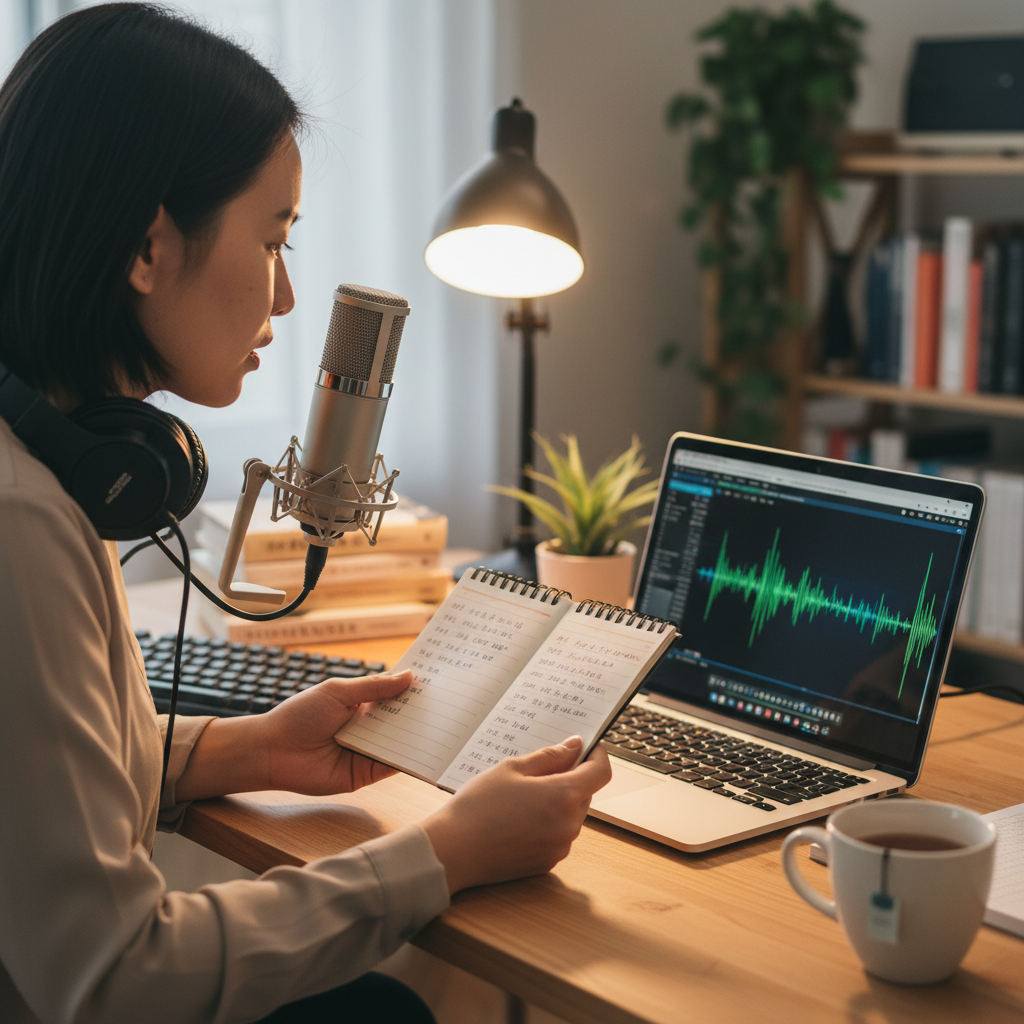
Recording Yourself Speaking Chinese: The Self-Assessment Technique That Accelerates Progress
Your perception of your own speech is unreliable. Recording yourself reveals the gap between what you think you sound like and what you actually sound like.
You know that cringe you feel when you hear your own voice on a recording? That discomfort is actually useful information. The difference between how you sound to yourself in real time and how you sound on a recording is the perception gap, and for Chinese learners, this gap is particularly significant.
When you speak Chinese, your brain is simultaneously producing speech and evaluating it. But the production task consumes most of your cognitive resources, leaving the evaluation function running at reduced capacity. You miss errors that would be obvious if you were only listening. A recording frees you from the production task and lets you evaluate with full attention.
Why Self-Recording Works
Self-recording provides three specific benefits that no other practice method can replicate.
First, it exposes tone drift. You may start a practice session with accurate tones and gradually drift as fatigue sets in or as you focus on other aspects of speech. Without recording, you never notice this drift. With recording, it is obvious on playback.
Second, it reveals habitual errors. When you listen to yourself on recording, patterns emerge. Maybe your fourth tone is consistently too gentle. Maybe your third tone always bounces. These patterns are invisible in real time but unmistakable across multiple recordings. Pairing recordings with the shadowing technique makes this even more powerful -- shadow a clip, record yourself, then compare.
Third, it provides a progress timeline. When you have recordings from month one, month three, and month six, you can hear your improvement in a way that day-to-day perception cannot detect. This is one of the most powerful motivational tools available to self-study learners.
What to Record
Different types of recordings serve different diagnostic purposes. A complete self-assessment practice includes all three types.
Type 1: Controlled Reading
Read a prepared text aloud and record it. This isolates pronunciation from the cognitive demands of composing speech. Use a text at or below your current level so you can focus entirely on how you sound rather than what you are saying. Compare your recording directly to native audio of the same text.
Type 2: Semi-Structured Speech
Answer a prepared question or describe a familiar topic for 60 to 90 seconds. You know the general content but not the exact words. This tests whether your pronunciation holds up under moderate cognitive load. Common prompts: describe your daily routine, talk about your hobbies, explain why you are learning Chinese.
Type 3: Free Conversation
Record yourself in actual conversation with a language partner, tutor, or AI chatbot. This reveals how your pronunciation performs under full conversational pressure -- the most demanding and most realistic test. Many errors that disappear in practice reappear in conversation.
Pro tip: Record all three types at least once per month and store them in dated folders. Your month-six conversation recording compared to your month-one conversation recording will show you more about your progress than any test score.
How to Listen Critically
Recording is only half the technique. Critical listening is the other half, and most learners do not know how to do it effectively. Here is a structured approach.
Critical listening protocol for your recordings:
- First listen: Focus only on tones. Ignore everything else. Mark any syllables where the tone sounds wrong or unclear.
- Second listen: Focus on individual sounds. Are your initials (consonants) clear? Are your finals (vowels) accurate? Mark any sounds that deviate from what you intended.
- Third listen: Focus on rhythm and flow. Does your speech sound choppy or fluid? Are you adding unnatural pauses? Is your speed consistent or erratic?
- Compare against native audio: If you recorded a controlled reading, play your version and the native version alternately, sentence by sentence. Note specific differences.
- Write down your three biggest issues: Prioritize them for your next practice session.
A-B Comparison Technique
The most effective way to use recordings for improvement is A-B comparison: play a native speaker saying a phrase, then immediately play your version of the same phrase, then the native version again. This side-by-side comparison makes differences that you might miss in isolation glaringly obvious.
Most audio editing is not necessary. Simply use two devices -- one playing native audio, one playing your recording -- and alternate. Or use a language tool that supports this comparison natively. The key is immediacy: hear the target, hear yourself, hear the target again, all within a few seconds.

Building the Recording Habit
The biggest barrier to self-recording is psychological discomfort. Nobody likes hearing their own voice, and hearing your own mistakes in a foreign language amplifies that discomfort. Here is how to overcome it.
Tips for making self-recording a consistent habit:
- Start small. Record one sentence per day for the first week. Just one. The goal is to normalize the act of recording, not to do comprehensive analysis.
- Record at the end of your study session when your pronunciation is warmed up and at its best. This builds positive associations.
- Do not listen to your recording immediately. Let 30 minutes pass. The temporal distance reduces the emotional sting of hearing errors.
- Focus on finding one thing you did well in each recording, not just errors. Positive reinforcement sustains the habit.
- Store recordings in a simple folder structure (month/week) so you can easily find old recordings for progress comparison.
Monthly Progress Reviews
Once per month, do a formal progress review. Record yourself reading a standard passage (use the same passage every month), then compare your current recording to your recording from the previous month. Score yourself on a simple 1-5 scale for tones, individual sounds, and fluency.
This monthly review serves two purposes. First, it provides objective evidence of improvement that combats the "I am not making progress" feeling that plagues self-study learners. Second, it identifies areas where improvement has stalled, redirecting your practice toward the specific skills that need attention.
"The recording does not lie. It does not flatter you and it does not discourage you. It simply shows you where you are. And knowing where you are is the prerequisite for getting where you want to go."
Track Your Pronunciation Progress Automatically
Our platform records your pronunciation on every exercise, tracks your accuracy scores over time, and shows you monthly progress reports -- so you always know exactly how your pronunciation is improving.
Related Articles
Shadowing Technique: Improving Chinese Pronunciation Through Imitation
How to Fix Your Chinese Pronunciation If You Have Been Learning Incorrectly
How to Practice Chinese Tones Online Without a Tutor (5 Proven Methods)
Written by Conor Martin AI
Creator of the Learn Chinese for Beginners YouTube channel and the Chinese AI learning platform. Helping thousands of people start their Mandarin journey with clear, structured, no-nonsense teaching.
Enjoyed this article?