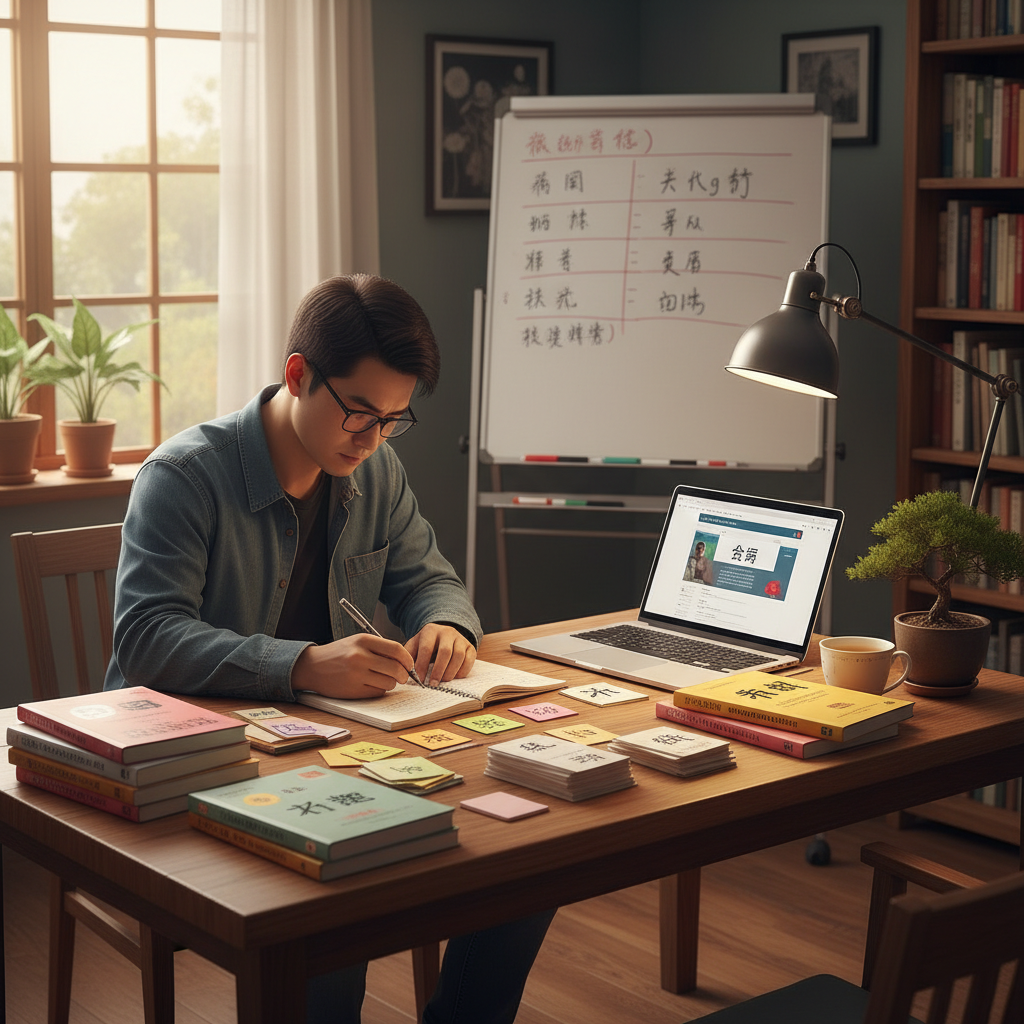
Learn Chinese Online by Myself Without a Teacher or Language School
A complete guide for the solo learner who wants to achieve real Chinese ability without ever setting foot in a classroom or hiring a tutor.
Somewhere along the way, a narrative took hold that Chinese is too difficult to learn without a teacher. That the tones are too tricky to self-correct. That the characters are too complex to self-study. That you need someone standing over you, listening to your pronunciation, correcting your grammar, guiding you through the labyrinth of a language that is, admittedly, very different from English.
This narrative was probably true 20 years ago. It is not true anymore. The tools available to independent learners in 2025 -- AI pronunciation feedback, adaptive spaced repetition, unlimited conversation practice with language models, pitch visualization, graded reading at every level -- collectively provide more targeted feedback and personalized instruction than most human teachers can offer in a group class setting. For a deeper look at whether a teacher is worth the investment, read our analysis of whether you need a Chinese teacher or can self-study.
That does not mean learning Chinese alone is easy. It means it is possible, and increasingly, it is the preferred approach for learners who value flexibility, efficiency, and self-direction over the structure and social aspects of a classroom. If you are someone who learns well independently -- if you have taught yourself other skills through books, videos, and practice -- you can teach yourself Chinese.
This guide is specifically for you. Not for the general "how to learn Chinese" reader, but for the person who has decided to do this alone and wants a detailed, honest roadmap for how to pull it off.
What Solo Learners Must Do That Classroom Students Get for Free
Before the practical advice, let me be clear about what you are taking on. A classroom provides five things that solo learners must consciously replace: curriculum sequencing (what to study and when), feedback on errors (especially pronunciation), accountability to show up, social motivation, and structured assessment of progress. If you do not actively build replacements for each of these, your independent study will drift, stagnate, or fail.
Replacing Curriculum Sequencing
A classroom teacher decides what you learn each week based on a tested syllabus designed for progressive skill building. Without this, solo learners often study whatever catches their attention, leading to a Swiss cheese knowledge base with random strengths and critical gaps.
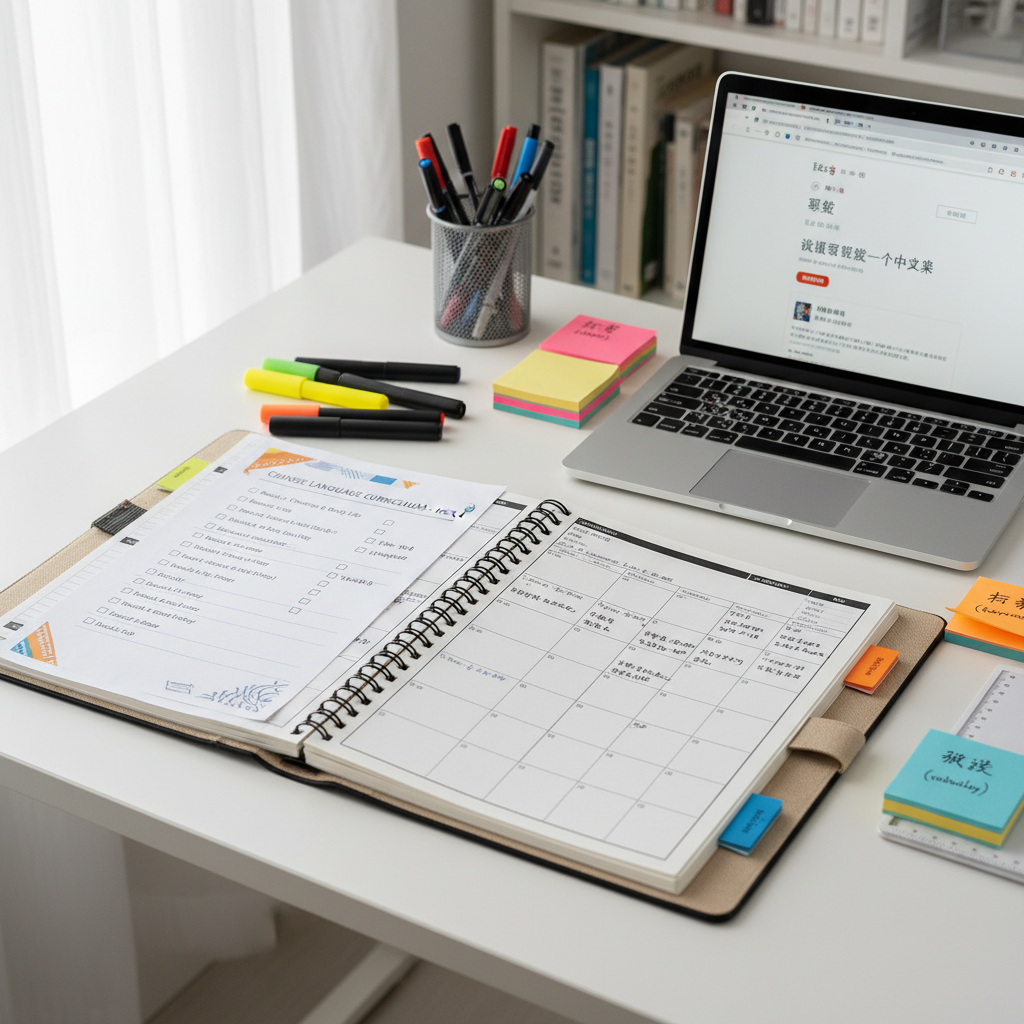
Your replacement is a structured learning platform or a detailed self-study syllabus that you follow with discipline. Our step-by-step self-study syllabus provides exactly this kind of sequential plan. Choose one primary resource that provides a sequential curriculum and commit to following it for at least three months before evaluating. Supplement it for specific weaknesses, but do not abandon it for a shinier alternative every two weeks. The switching cost of starting over on a new platform is enormous and is the primary way solo learners waste time.
Replacing Error Feedback
This is the one that everyone worries about, and the one where technology has made the most dramatic progress. AI pronunciation tools can now analyze your speech at a granularity that most human teachers cannot match. They detect which specific tone is wrong, whether your pitch curve started at the wrong height, whether your retroflex consonants are actually retroflex or just close approximations. This level of feedback was impossible for solo learners even five years ago.
For grammar errors, AI conversation partners can identify and correct common mistakes in real time. They are not perfect -- they sometimes miss subtle errors or overcorrect natural variation -- but they catch the major structural mistakes that would impede communication. Combine AI feedback with regular self-recording and comparison to native models, and your error correction infrastructure is robust.
Replacing Accountability
This is where most solo learners fail, and it has nothing to do with Chinese. It is a human motivation problem. Without a class to attend, a teacher to face, or a grade to earn, the only thing forcing you to study is your own discipline. On tired days, busy days, frustrated days, discipline alone is often not enough.
Accountability systems that work for solo learners:
- Habit stacking: Attach Chinese study to an existing daily habit. Study immediately after morning coffee. Study during your lunch break. Study on the bus. When Chinese study is part of a routine, it requires less willpower than when it is a standalone task.
- Streak tracking: Use a simple calendar where you mark each day you study. The desire to maintain an unbroken streak is a powerful motivator, even when the material is hard.
- Public commitment: Tell someone you are learning Chinese. Post weekly progress updates. Join an online community of Chinese learners. The social pressure of having declared your goal keeps you showing up on days when intrinsic motivation is low.
- Micro-commitments: On your worst days, commit to just 5 minutes. Five minutes is better than zero, and more often than not, starting for 5 minutes turns into 15 or 20. The hardest part is starting.
- Weekly milestone reviews: Every Sunday, check whether you hit your study targets for the week. If you missed more than one day, diagnose why and adjust your schedule for the following week. Do not just notice the miss -- understand and fix the cause.
Pro tip: The most successful solo learners I have observed share one trait: they treat their study sessions as non-negotiable appointments. Not "I will study if I have time" but "I study at 7:15 AM every morning." The specificity of the commitment matters. Vague intentions produce vague results.
Replacing Social Motivation
Learning alone does not mean learning in isolation. Online communities of Chinese learners are large, active, and supportive. Find one that matches your level and goals. Participate regularly. Share your struggles and successes. Ask questions. Answer questions from learners behind you -- teaching others reinforces your own knowledge powerfully.
Language exchange platforms connect you with native Chinese speakers learning English. These relationships provide social motivation, cultural insight, and real speaking practice. Even one 30-minute exchange per week adds a human dimension to your learning that purely digital tools cannot replicate.
Replacing Structured Assessment
Without tests and grades, how do you know if you are progressing? You build your own assessment system. Monthly recording reviews (record yourself speaking, compare to previous months). HSK practice tests at regular intervals (free online). Vocabulary counts from your spaced repetition system. Reading speed measurements. AI conversation duration and complexity tracking. These metrics give you objective data where a classroom would give you test scores.

The Solo Learner's Daily System
A system beats willpower every time. Here is a daily system designed for the solo Chinese learner that covers all necessary skills in a sustainable format.
The daily system (45-60 minutes, split-friendly):
- Block 1 - Review (10 minutes, morning): Spaced repetition for all due vocabulary and character cards. This is your retention engine. Never skip it, even on bad days. If you only do one thing, do this.
- Block 2 - New Input (15 minutes, any time): Work through the next section of your structured curriculum. Learn new vocabulary, grammar patterns, or characters. Watch or listen to a lesson. Take notes on anything that is not immediately clear.
- Block 3 - Listening (10 minutes, commute or break): Active listening to Chinese audio at your level. Podcast, YouTube, or graded listening material. Focus on comprehension, not just background exposure.
- Block 4 - Speaking (15 minutes, evening): AI conversation practice or self-narration. Produce original Chinese sentences. Read your flashcards aloud with correct tones. Shadow a short audio clip. Record the last 2 minutes for weekly comparison.
- Block 5 - Reading (10 minutes, before bed): Read Chinese text at your level. Graded readers for the first few months, then transitioning to simple native content. Read for flow, not for perfection.
The blocks are designed to be independent and moveable. If your schedule does not allow a continuous 60-minute session, do blocks at different times throughout the day. The order matters less than the consistency. Distributed practice (multiple shorter sessions across the day) actually produces better retention than massed practice (one long session), so splitting is an advantage, not a compromise.
The Three Crises of Solo Chinese Learning
Every solo learner hits three predictable crises. Knowing they are coming does not prevent them, but it prevents you from interpreting them as signs that solo learning does not work or that you are not capable.
Crisis 1: The Tone Wall (Weeks 2-4)
You realize that you cannot hear the difference between second and third tone. You record yourself and discover your tones are inconsistent. You feel like you will never get this. This crisis resolves with persistent daily tone practice and the gradual realization that tone accuracy is a spectrum, not a binary. You do not need perfect tones. You need tones that are consistent enough for native speakers to understand you, and that threshold is lower than you think.
Crisis 2: The Progress Plateau (Months 2-3)
The initial rapid progress of the first month slows dramatically. New vocabulary feels harder to retain. Grammar patterns are more complex. You can produce rehearsed phrases but freeze when trying to say something new. The gap between your ability and your goal feels enormous.
This is the most dangerous crisis because it is where the majority of solo learners quit. The solution is to reduce expectations temporarily, focus on maintaining your review habit, and find enjoyable Chinese content at your level. Progress has not stopped -- it has shifted from visible (learning new things) to invisible (consolidating and deepening what you know). This invisible progress is just as important, but it does not feel like progress, which is why so many people mistake it for failure.
Crisis 3: The Comparison Trap (Months 4-6)
You see other learners online who seem more advanced. You read about someone who "became conversational in three months." You wonder if you are doing something wrong. This crisis is entirely psychological and entirely common. The solution is to compare yourself only to your past self. Listen to your month-one recordings. Take an HSK practice test and compare to your score from two months ago. Look at your vocabulary count today versus three months ago. Your progress is real. Other people's claimed progress is unverifiable and often exaggerated.

When Solo Learning Is Better Than a Teacher
I want to make a counterintuitive argument: for many learners, solo study with modern tools is actually better than having a teacher. Here is why.
First, you practice more. A one-hour class with a teacher involves maybe 10 to 15 minutes of you actually speaking. The rest is the teacher speaking, other students speaking, transitions, and administrative overhead. A 45-minute solo session can include 15 minutes of pure speaking practice, which is more production time than a 90-minute group class.
Second, you review more efficiently. A teacher assigns homework that may or may not target your specific weaknesses. Spaced repetition algorithms know exactly which words you are about to forget and review them at the optimal moment. This mathematical precision in review scheduling is something no human teacher can replicate.
Third, you make more mistakes without consequence. Speaking to a teacher involves social pressure that suppresses risk-taking. You stick to phrases you know rather than attempting constructions you are uncertain about. With an AI partner, you can produce terrible Chinese, get corrected, and try again without any social cost. Mistakes are the raw material of learning, and solo study lets you make more of them.
Fourth, you study at your optimal times. Your brain has hours of peak cognitive function and hours of low function. Solo study lets you schedule new learning during peaks and review during valleys. Classroom schedules ignore your cognitive rhythms entirely.
When Solo Learning Falls Short
Intellectual honesty requires acknowledging where solo learning has genuine disadvantages. Cultural nuance is hard to learn without human interaction. The pragmatics of Chinese conversation -- when to be formal, when to use indirect language, how to navigate social hierarchies -- are best absorbed through real human interaction, not AI simulation.
Motivation over the long term is harder to sustain alone. A teacher who knows your goals and checks in weekly provides a form of external motivation that is difficult to manufacture. If you are someone who struggles with self-direction, a teacher might be worth the cost specifically for the accountability they provide.
Advanced pronunciation refinement benefits from a trained human ear. AI pronunciation tools are excellent for catching clear errors but less reliable for subtle issues that distinguish good pronunciation from great pronunciation. If your goal includes professional-level Chinese, a human pronunciation coach is valuable at the intermediate-to-advanced stage.
"Solo learning is not a consolation prize for people who cannot afford a teacher. It is a legitimate, often superior approach for learners who have the self-discipline to build a system and the honesty to assess their own progress. The question is not whether you can learn Chinese alone. It is whether you are willing to build and maintain the systems that make it work."
Solo Learning with Built-In Structure
Our platform was designed for independent learners. It provides the curriculum sequencing, pronunciation feedback, and progress tracking that solo learners need -- without requiring a teacher, a classroom, or a fixed schedule. Study at your pace, on your terms.
Related Articles


Written by Conor Martin AI
Creator of the Learn Chinese for Beginners YouTube channel and the Chinese AI learning platform. Helping thousands of people start their Mandarin journey with clear, structured, no-nonsense teaching.
Enjoyed this article?