
Do You Need a Chinese Teacher or Can You Self-Study Effectively?
An honest comparison of both paths -- with the surprising answer that the best approach is neither in isolation.
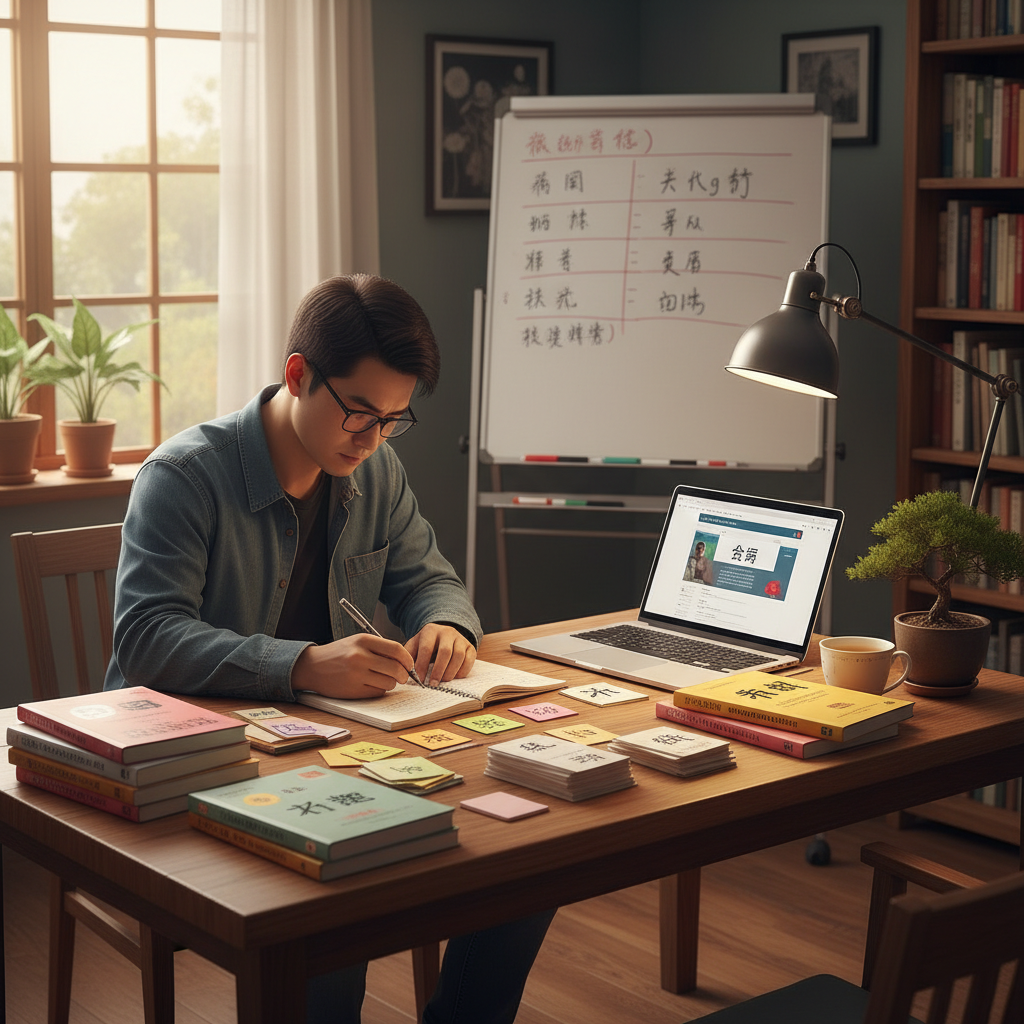
Every Chinese learning forum eventually has this debate. One side says you need a teacher -- that Chinese is too complex, too nuanced, too different from English to learn on your own. The other side says self-study is superior -- it is more flexible, more efficient, and modern tools have eliminated the need for human instruction.
Both sides are partially right and partially wrong. The answer is not either-or. It depends on your level, your budget, your learning style, and what specific skills you are trying to develop. Let me break it down honestly.
What Teachers Do Best
A good Chinese teacher provides things that no app or book can fully replicate. They notice patterns in your errors that you cannot see yourself. They adjust explanations in real time when you are confused. They provide cultural context and usage nuance that reference materials miss. And they hold you accountable -- canceling a lesson feels worse than skipping a flashcard session.
Teachers excel at:
- Correcting fossilized pronunciation errors (mistakes you make so consistently you no longer notice them)
- Explaining cultural context that affects language use
- Providing unstructured conversation practice that adapts to your interests
- Catching and correcting grammar errors in real-time speech
- Motivating you through accountability and personal relationship
- Answering the "why" questions that arise from genuine curiosity
What Self-Study Does Best
Self-study has its own set of advantages that teachers cannot match. You can study at any time, for any duration, at your own pace. You can repeat the same content as many times as you need without boring or inconveniencing anyone. You can use spaced repetition algorithms that are far more efficient at scheduling vocabulary review than any human could be.
Self-study excels at:
- Vocabulary acquisition through spaced repetition (the most efficient memorization method known)
- Flexible scheduling that adapts to your life rather than demanding fixed appointments
- Cost efficiency -- a fraction of the price of regular tutoring
- Repetitive drilling of pronunciation, tones, and grammar patterns
- Self-paced progression that does not hold you back or push you forward too fast
- Unlimited practice time with AI conversation partners

The Case for Self-Study First
For absolute beginners, I recommend starting with self-study and adding a teacher later. We cover this path in depth in our guide on learning Chinese by yourself without a teacher. Here is why.
The first three months of Chinese are primarily about building a foundation: learning pinyin, training your ears for tones, memorizing basic vocabulary, and internalizing simple grammar patterns. These are tasks that benefit more from consistent daily repetition than from expert instruction. A teacher can teach you what the four tones are in one lesson, but actually hearing and producing them requires hundreds of repetitions -- repetitions that are more efficiently done with audio tools and AI feedback than with a human teacher watching you repeat "ma" for the hundredth time.
Additionally, beginner-level content is well-covered by structured online courses. The material is standardized, the explanations are established, and there is little room for creative teaching at this stage. A teacher's unique value -- nuanced explanations, cultural insight, real-time adaptation -- does not fully kick in until you have enough language to benefit from those things.
When to Add a Teacher
The ideal time to add a human teacher is around the HSK 2 to 3 transition, roughly six to nine months into study. At this point, you have enough Chinese to have real conversations, which means a teacher's time is spent on actual instruction rather than basic drilling. You can ask informed questions. You can attempt complex sentences that need real-time correction. You start encountering cultural nuances that benefit from human explanation.
At this stage, even one hour per week with a teacher can dramatically accelerate progress. The teacher handles what AI and self-study cannot: catching subtle errors, explaining usage differences between similar words, and pushing you to express ideas that stretch your current ability.
The AI Factor
AI conversation partners have changed this equation significantly. Before AI, the biggest weakness of self-study was the lack of speaking practice with feedback. You could listen to recordings and read textbooks, but producing Chinese and getting corrected required either a teacher or a very patient language exchange partner.
AI tools now provide instant pronunciation feedback, adaptive conversation practice, and grammar correction at any hour of the day. They do not replace the depth of human interaction, but they fill the gap well enough that self-study learners can develop genuine speaking skills without regular human tutoring.
Think of AI as your daily training partner and a human teacher as your weekly coach. The training partner is available every day for as long as you want, handling the repetitive work of building muscle. The coach comes in periodically to refine your technique, correct bad habits, and push you to the next level.
Pro tip: The combination of AI daily practice and occasional human teaching is emerging as the most cost-effective and efficient approach to learning Chinese. It gives you the consistency of self-study with the correction and nuance of human instruction.
The Budget Reality
Cost is a legitimate factor. Online Chinese tutors charge anywhere from $10 to $60 per hour depending on experience and qualifications. Two lessons per week at $20 per hour costs roughly $160 per month. That is a significant ongoing expense that not everyone can justify, especially in the early months when the content could be learned through self-study.
A structured online learning platform typically costs $10 to $30 per month. For the first six months, a well-chosen platform plus free resources provides roughly equivalent learning outcomes to regular tutoring at a fraction of the cost. Adding tutoring later, when you can benefit from it most, is the financially optimal approach.
The Honest Limitations of Self-Study
Self-study is not perfect. It requires more self-discipline because there is no one else expecting you to show up. It can feel isolating. And there are certain types of errors -- particularly pronunciation fossils and unnatural phrasing -- that self-study tools can miss or inadequately correct.
Self-study also lacks the social motivation that classes provide. Some people genuinely learn better in social settings, and if that describes you, the accountability and community of a class may justify the higher cost even at the beginner stage.
The Recommended Approach
Based on cost-effectiveness, learning outcomes, and practical constraints, here is what I recommend for most adult learners.
The optimal learning approach by phase:
- Months 1-6: Self-study with a structured platform and AI conversation practice. Daily 30-minute sessions. Cost: $10-30 per month.
- Months 6-12: Continue self-study as your base. Add one weekly session with a human tutor for pronunciation correction, cultural questions, and unstructured conversation. Cost: $50-80 per month total.
- Year 2+: Self-study for vocabulary and reading. Weekly or bi-weekly tutoring for conversation fluency and advanced correction. Gradually replace structured lessons with native content consumption.
This approach optimizes for budget, effectiveness, and the specific strengths of each learning mode. It is not the only valid approach, but it is the one I have seen produce the most consistent results across the widest range of learner profiles.
Start Self-Study with AI-Powered Guidance
Our platform provides the structured curriculum, AI conversation practice, and progress tracking that makes self-study effective -- giving you a strong foundation before you ever need a human teacher.
Related Articles

Written by Conor Martin AI
Creator of the Learn Chinese for Beginners YouTube channel and the Chinese AI learning platform. Helping thousands of people start their Mandarin journey with clear, structured, no-nonsense teaching.
Enjoyed this article?