How to Learn Chinese Online When You Only Have 30 Minutes a Day
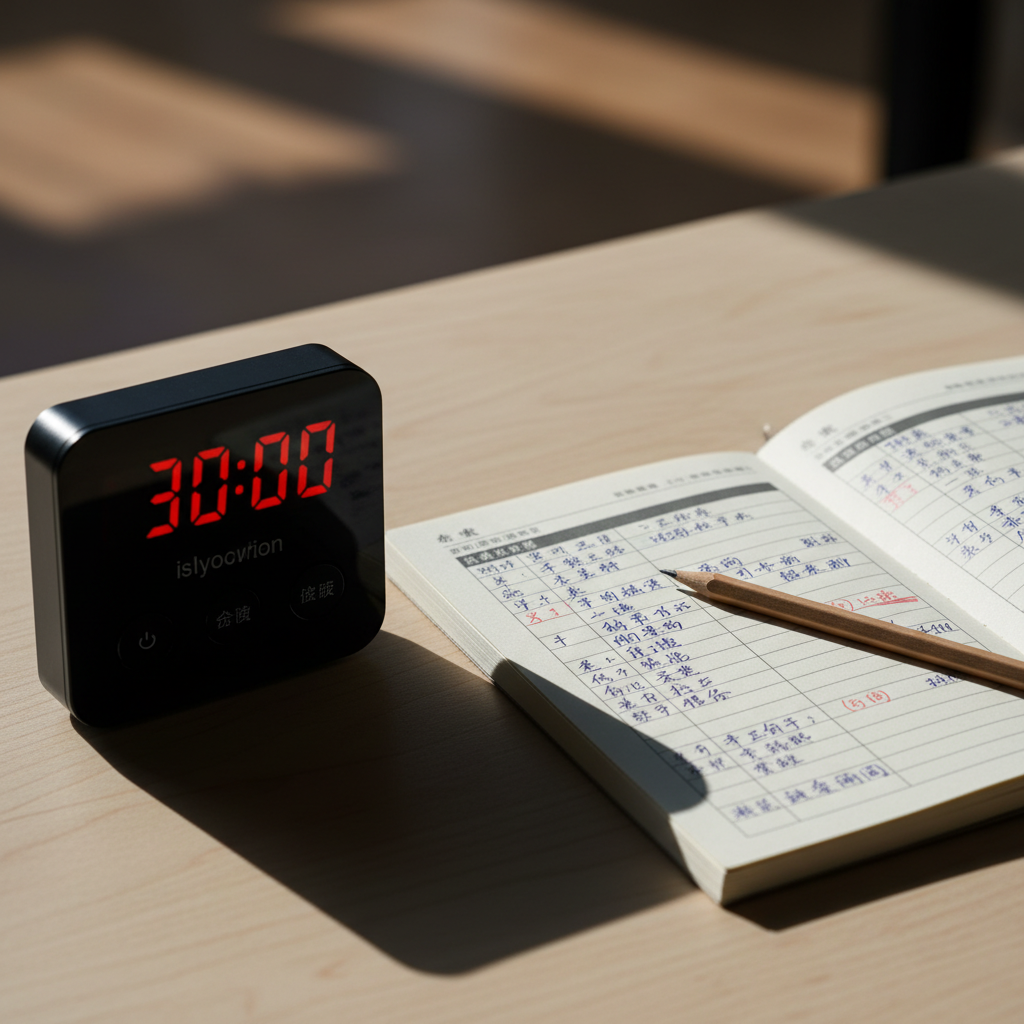
Thirty minutes is not a limitation. It is a constraint that forces efficiency, eliminates waste, and produces better per-minute results than the unfocused hour most learners spend. Here is how to use every second.
Thirty minutes a day for Chinese study is 182 hours a year. For perspective, the Foreign Service Institute estimates that English speakers need 2,200 classroom hours to reach professional fluency in Chinese. At 30 minutes a day, you are looking at roughly 12 years to reach that benchmark through study time alone.
That math sounds discouraging, but it is misleading. The FSI estimate assumes a traditional classroom with its inherent inefficiencies -- waiting for other students, reviewing material you already know, doing activities below your level. A focused self-study session is three to five times more efficient per minute than a group classroom hour. And conversational competence -- the ability to discuss everyday topics with native speakers -- requires far less than professional fluency. Conversational Chinese is achievable in 12 to 18 months at 30 minutes daily if those minutes are spent optimally.
The key phrase is "spent optimally." Thirty minutes leaves no room for wasted time. You cannot afford unfocused review, inefficient study methods, or activities that feel productive but do not develop skills. Every minute must serve a clear purpose in a structured system. Here is that system.
The 30-Minute Session Architecture
The optimal 30-minute session balances three essential activities: retention (keeping what you have learned), acquisition (learning new material), and production (actively using Chinese). Skipping any one of these leads to specific failure modes: without retention, you forget faster than you learn; without acquisition, you plateau; without production, you can recognize Chinese but cannot speak it.
The daily 30-minute split:
- Minutes 1-8: Spaced repetition review (retention). Launch your SRS app and complete today's reviews. Do not add new cards during this time. Just maintain what you have already learned. This should feel fast -- if reviews take longer than 8 minutes, reduce your daily new card count.
- Minutes 9-20: New material and skills (acquisition). Study one lesson section, learn new vocabulary in context, practice listening to new content, or work through grammar exercises. This is where your Chinese grows. Focus on a single skill per session rather than splitting across multiple skills.
- Minutes 21-28: Active production (output). Speak out loud. Have an AI conversation. Do a shadowing exercise. Construct original sentences. This is the highest-value portion of your session because production builds the neural pathways that recognition alone cannot.
- Minutes 29-30: Add new SRS cards (setup). Add 3-5 new vocabulary items from today's lesson to your SRS system. Brief and mechanical -- just queue them for tomorrow.
Pro tip: The exact time split is flexible. Some days you might need 12 minutes for reviews and only 6 minutes for production. Other days reviews might take 5 minutes and you can spend 11 minutes on production. The architecture matters more than the exact allocation. Retention, then acquisition, then production -- every session, without exception.
Maximizing Efficiency Within Each Block
Making SRS Reviews Faster
SRS reviews should take 5 to 8 minutes for a sustainable daily practice. If they are taking longer, you have one of two problems: too many new cards being added daily, or cards that are poorly designed and take too long to process individually.
For time-constrained learners, limit new SRS cards to 3 to 5 per day. This produces a daily review load of about 20 to 35 cards, completable in 5 to 8 minutes. It sounds slow -- 3 to 5 new words per day is only 1,000 to 1,800 per year -- but consistent daily retention of those words is worth more than rapid acquisition followed by mass forgetting.
Card design matters for speed. Each card should be answerable in under 5 seconds. If you regularly stare at a card for 10 to 15 seconds trying to recall the answer, the card is either too hard or testing something that is not yet ready for SRS. Cards should have clear, unambiguous prompts and single correct answers. Remove or redesign any card that consistently takes too long.
Making Acquisition Blocks More Dense
The acquisition block is where most learners waste time. Common time-wasters include: re-reading material you already understand, watching lesson videos at 1x speed when you could comprehend at 1.5x, doing easy exercises that confirm knowledge without building new skills, and switching between multiple resources instead of progressing through one.
Rules for efficient acquisition:
- Never review material you can already pass a test on. Move forward always. Use SRS for retention, not re-study.
- Watch video content at 1.25x to 1.5x speed. Your comprehension will be the same and you save 20 to 30 percent of the time.
- Skip exercises that are too easy. If you can answer without thinking, the exercise is wasting your time.
- Use one primary resource, not three. Switching between apps and courses wastes minutes and fragments your progress.
- If a lesson takes longer than one session, split it across two days. Do not sacrifice production time to finish a lesson.
Making Production Blocks Count
Seven to eight minutes of production practice may seem inadequate. It is enough if you maximize intensity. The key is eliminating dead time -- pauses where you are thinking in English, searching for words, or waiting for an AI response.
The most time-efficient production exercise is timed sentence production. Set a timer for 5 minutes. Produce as many original Chinese sentences as possible, speaking aloud. Use vocabulary from recent lessons. Do not stop to correct yourself -- produce, move on, produce more. This builds fluency (speed of production) rather than accuracy. Accuracy comes from the acquisition block. Production time is for speed.
For conversation practice, set your AI partner to a focused mode -- one topic, no tangents, continuous dialogue. A 7-minute focused conversation on a single topic produces more learning than a 20-minute wandering conversation that touches five topics superficially.

The Weekly Rhythm for 30-Minute Learners
Daily sessions should not all be identical. Varying the focus of your acquisition and production blocks across the week ensures balanced skill development without trying to cram everything into a single session.
Suggested weekly rotation:
- Monday: New vocabulary acquisition + vocabulary production (construct sentences with new words)
- Tuesday: Listening practice + shadowing (repeat what you hear, matching tone and rhythm)
- Wednesday: Grammar focus + AI conversation practice
- Thursday: Listening practice + dictation (write what you hear in pinyin)
- Friday: New vocabulary acquisition + vocabulary production
- Saturday: Extended conversation practice (use the full 20 minutes for production if possible)
- Sunday: Review and catch-up day (review anything from the week that did not stick, no new material)
This rotation ensures that over every week you practice all four skills (listening, speaking, reading, writing), learn new vocabulary and grammar, and maintain what you have already learned. No single day tries to do everything. Each day does one thing well.
Stealing Extra Minutes Without Dedicated Study Time
Your 30 focused minutes are the core of your learning system. But you can amplify their impact with micro-practice throughout the day that requires no dedicated study time.
Micro-practice opportunities:
- Commute: Listen to Chinese audio (podcasts, audio lessons, or music). Even passive listening builds familiarity with speech patterns. 10 to 30 minutes per day, zero additional time cost.
- Waiting in line: Open your SRS app and do 5 to 10 extra reviews. Two minutes here and there adds up to significant additional retention over a month.
- Shower or getting ready: Mentally rehearse Chinese sentences. Practice self-introduction, describe your plans for the day, or count objects you see. Silent or whispered production practice.
- Before bed: Listen to one Chinese dialogue or short story. Falling asleep to Chinese is not effective study, but the 5 to 10 minutes before sleep when you are still attentive is a genuine learning window. For more on timing your study optimally, see our guide on the best time of day to study Chinese.
- Phone settings: Change your phone language to Chinese. Every interaction with your phone becomes a micro-reading exercise.
These micro-practices do not replace your 30-minute session. They supplement it. A learner who does 30 focused minutes plus 20 to 30 minutes of micro-practice is effectively studying 50 to 60 minutes daily while only carving out 30 minutes of dedicated time. Over a year, those micro-minutes contribute 120 to 180 additional hours of exposure.
Realistic Progress Expectations
Being honest about progress expectations prevents the discouragement that kills long-term consistency. Here is what 30 focused minutes daily typically produces.
Expected milestones at 30 minutes per day:
- After 1 month: Solid pronunciation and tone foundation. 80 to 100 words. Can introduce yourself and handle the most basic exchanges.
- After 3 months: 250 to 350 words. Can handle simple conversations on familiar topics. Approximately HSK 1 level.
- After 6 months: 500 to 700 words. Can discuss daily topics, express basic opinions, and follow slow spoken Chinese on familiar topics. Approximately HSK 2 level.
- After 12 months: 1,000 to 1,200 words. Can hold sustained conversations on a range of everyday topics. Can understand the gist of native-speed speech on familiar topics. Approaching HSK 3.
- After 18 months: 1,500 to 1,800 words. Comfortable conversational ability on everyday topics. Can read simple Chinese text. Can express opinions and discuss plans. Solid HSK 3.
These milestones assume consistent daily practice with the structured approach described above. Missed days, unfocused sessions, and method-switching all slow progress. But even with imperfect consistency -- let us say you study 25 days per month instead of 30 -- you will still progress meaningfully if your study sessions are structured and focused.
The One Thing That Matters More Than Minutes
Consistency trumps duration. A learner who studies 30 minutes every day for 12 months will dramatically outperform a learner who studies 2 hours a day for 3 months and then stops. The 30-minute learner accumulates 182 hours. The intensive learner accumulates 180 hours. The hours are nearly identical, but the 30-minute learner's hours are spaced across 365 days of repeated exposure, spaced repetition, and gradual skill building. The intensive learner's hours are compressed into 90 days, which means less time for memories to consolidate, less spacing effect for retention, and a harder habit to maintain.
Thirty minutes is sustainable. Two hours is not, for most people with jobs, families, and other commitments. Sustainability is the single most important feature of a study plan, because the plan you abandon after two months teaches you nothing, regardless of how many hours it contained.
"You do not need more time. You need a system that respects the time you have. Thirty minutes of structured daily practice will take you further in Chinese than you currently believe possible. The math is not intuitive, but it is relentless: small consistent investments compound over months into surprising results."
Designed for Busy Learners
Our lessons are built for the 30-minute window. Each session combines structured learning, spaced repetition, and AI conversation practice in a format that respects your time and maximizes every minute.
Related Articles


Written by Conor Martin AI
Creator of the Learn Chinese for Beginners YouTube channel and the Chinese AI learning platform. Helping thousands of people start their Mandarin journey with clear, structured, no-nonsense teaching.
Enjoyed this article?