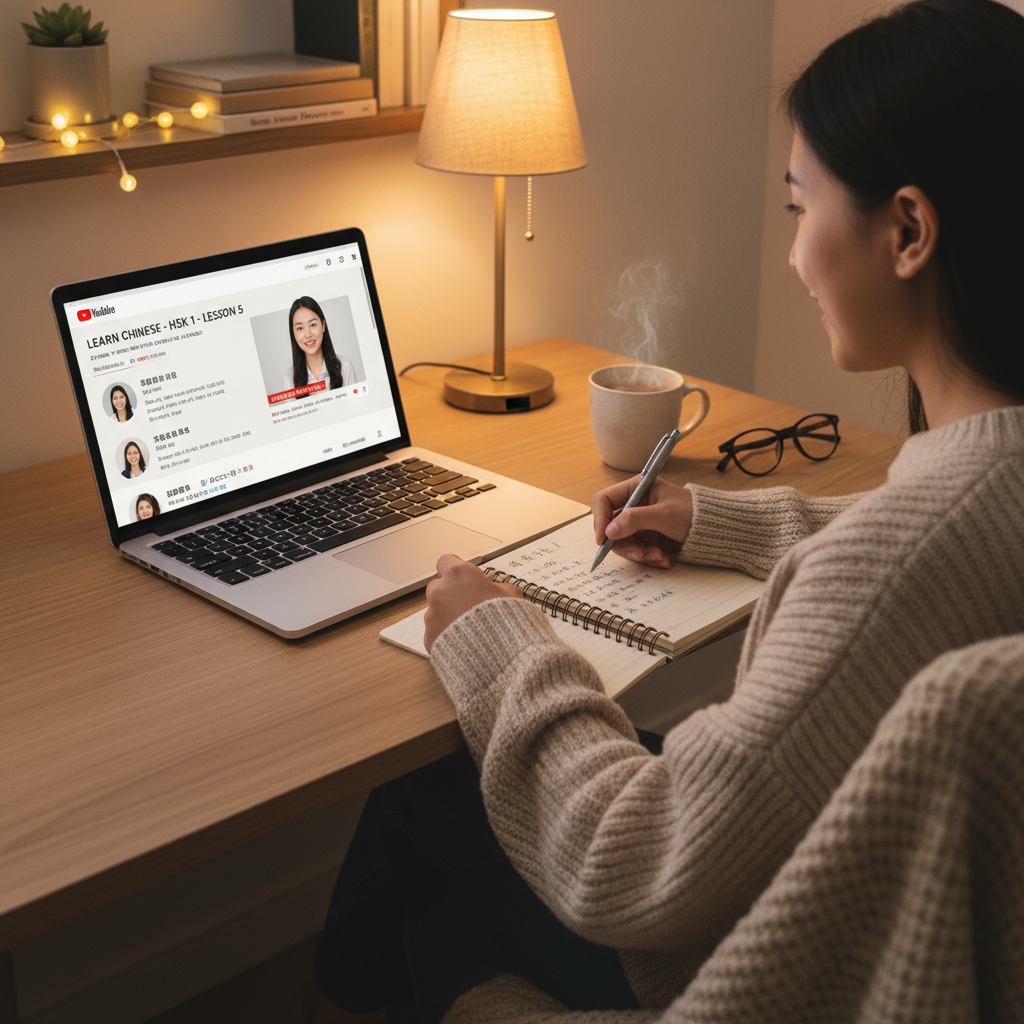
How to Learn Chinese Online Using Only YouTube and Free Resources
A detailed roadmap for learning Mandarin without spending a cent, built around YouTube as your primary classroom and free tools filling every gap.
YouTube is the largest repository of free Chinese language instruction ever assembled. There are thousands of channels, tens of thousands of videos, covering every conceivable topic from basic pinyin to advanced business Chinese. Some of these videos are genuinely excellent -- better than what you will find in many paid courses. Others are mediocre, misleading, or flat-out wrong.
The opportunity and the problem are the same: unlimited choice with no curation. If you search "learn Chinese" on YouTube, you get over 10 million results. How do you build a coherent learning path from that? How do you ensure you are covering all the necessary skills and not just the ones that make for entertaining videos? How do you avoid the trap of watching video after video while feeling productive but never actually acquiring the ability to speak, listen, read, or write?
This article answers those questions. It provides a structured approach to using YouTube and other free resources as your complete Chinese learning system. If you want a broader look at the free learning landscape beyond YouTube, check out our guide on how to learn Chinese online for free without Duolingo. It is not as efficient as a well-designed paid platform -- I will be honest about that -- but it is effective if you follow it with discipline.
The YouTube Trap: Passive Consumption Disguised as Learning
Before we get into the plan, I need to address the biggest risk of YouTube-based learning. YouTube is designed for passive consumption. You sit, you watch, you feel like you are absorbing information. The algorithm serves you another video. You watch that too. An hour passes. You feel productive. But when you close the browser and try to say something in Chinese, nothing comes out.
This is because watching a video about Chinese is not the same as practicing Chinese. The video is input. You also need output (speaking and writing), processing (active listening and reading), and reinforcement (spaced repetition review). YouTube provides the input beautifully. The other three components require you to actively supplement what you watch with practice that happens away from the screen.
Pro tip: Rule for YouTube-based learning: for every minute you spend watching a video, spend at least one minute practicing what you learned away from the video. If you watch a 10-minute lesson on food vocabulary, spend at least 10 minutes saying those words aloud, making sentences with them, and adding them to your review system. Watching without practicing is entertainment, not education.
Choosing the Right Channels
Not all Chinese teaching channels are worth your time. After reviewing dozens of channels, certain quality markers separate the excellent from the mediocre.
Markers of a high-quality Chinese teaching channel:
- Native or near-native pronunciation by the instructor. If the teacher's own Chinese has noticeable accent issues, their instruction will transfer those issues to you.
- Systematic progression from one video to the next. The best channels have playlists organized by level that build sequentially, not random topic videos in no particular order.
- Tone marks are consistently shown on all pinyin. Channels that show pinyin without tones are teaching you to ignore the most important feature of Chinese pronunciation.
- Real example sentences rather than just vocabulary lists. A word in isolation is less useful than a word in three different contexts.
- The instructor explains not just what to say but how to pronounce it, with close-ups of mouth position for difficult sounds.
- Cultural context is woven into lessons rather than ignored. Language without culture is a code, not communication.
Red flags that suggest a channel will waste your time:
- Clickbait titles promising fluency in impossibly short timeframes ("Learn Chinese in 10 minutes!")
- No systematic structure -- just random vocabulary videos with no learning progression
- The instructor speaks mostly English and treats Chinese words as novelties rather than as a system to be learned
- No pinyin, no tone marks, and no pronunciation guidance
- Comments section full of viewers who have been watching for months and still cannot form basic sentences
The YouTube-Based Learning Plan: Month by Month
Month 1: Foundation Building
Your first month should focus on three things: pinyin and tones, basic vocabulary, and establishing a daily routine. YouTube handles the first two well. The third is on you.
Find a comprehensive pinyin series on YouTube -- one that covers all 21 initials, all 35 finals, and all four tones with clear audio and mouth position demonstrations. Work through it systematically over the first two weeks, pausing after each sound to practice producing it yourself. Record your attempts on your phone and compare to the video. This active engagement transforms a passive video into an effective pronunciation lesson.
For basic vocabulary, find a channel with a "first 100 words" or "beginner vocabulary" playlist. Watch one lesson per day. After watching, write down all new words with pinyin and tones. Add them to a free spaced repetition tool. Practice saying each word aloud five times with deliberate tone attention. This post-video practice is where the actual learning happens.
Supplement YouTube with a free pinyin chart that has clickable audio for every sound. Use this as your reference throughout the month. When a video introduces a new word, check its pronunciation against the chart. When you are unsure of a tone, look it up. The chart is your quality control for the potentially variable pronunciation quality across different YouTube teachers.
Month 2: Grammar Patterns and Conversation Foundations
Shift your YouTube diet to grammar lesson videos. Look for channels that teach grammar through sentence patterns with multiple examples rather than through abstract rules. Your target for this month is 15 to 20 sentence patterns that cover basic communication: expressing wants, describing things, asking questions, talking about time and location, and using basic conjunctions.
Begin watching "Chinese with comprehensible input" videos -- a growing genre where the teacher speaks only in Chinese using simple vocabulary, gestures, and visual aids to make themselves understood. These videos are profoundly effective for developing listening comprehension and natural language acquisition. They bypass the translation layer and teach your brain to process Chinese directly.
For speaking practice, use a free AI conversation tool or start a language exchange. YouTube cannot provide this -- it is one-directional by nature. You must actively seek out opportunities to produce Chinese, not just consume it. Even 10 minutes per day of speaking practice makes an enormous difference compared to video-only study.

Month 3: Character Introduction and Listening Expansion
Find a YouTube channel that teaches Chinese character radicals systematically. The best ones show how characters are built from component parts, explain the logic behind character construction, and provide memorable stories or associations for learning them. A good radical series watched over the course of a month will give you the ability to decode characters you have never seen before, which is far more valuable than memorizing individual characters.
Expand your listening practice to Chinese podcasts for learners. Several excellent ones are available free on standard podcast platforms, and we cover the best options in our guide to online Chinese listening practice with transcripts. Use YouTube for video-based learning and podcasts for audio-only practice. Audio-only practice is important because it forces your brain to process Chinese without visual cues, which is the condition you will face in real conversation.
Months 4-6: Immersion and Independence
As your Chinese improves, shift from instructional YouTube content to native Chinese content with Chinese subtitles. Start with channels made for Chinese children or teens -- the language is simpler, topics are visual, and the pacing is manageable. Progress to vlogs, cooking channels, and travel content where you can infer meaning from visual context even when the language is challenging.
Begin watching short clips from Chinese TV shows or movies. Use the pause-study-replay technique: watch a short scene, pause, write down what you understood, look up unknown words, then rewatch. This is laborious but extraordinarily effective for building comprehension of natural speech with its contractions, slang, and emotional variation.
Continue using instructional YouTube channels for specific grammar points or pronunciation refinement, but the majority of your YouTube time should now be native content. This transition from studying Chinese to using Chinese is the critical shift that separates learners who plateau from learners who continue improving.
The Free Tool Stack That Fills YouTube's Gaps
YouTube provides video instruction and listening input. It cannot provide spaced repetition, speaking practice, pronunciation feedback, or structured character learning. Here are the free tools that complete the picture.
Essential free supplementary tools:
- Spaced repetition software: Build your own decks from vocabulary you encounter in videos. Add audio from YouTube clips when possible. Review daily for 10-15 minutes.
- Free AI chatbot: Use for daily speaking practice. Even 5 minutes of conversation practice per day keeps your production skills developing alongside your comprehension.
- Online Chinese dictionary with audio: Look up every word you encounter. Check pronunciation against the dictionary, not just against the YouTube teacher. Use the dictionary's example sentences for context.
- Free grammar wiki: When a YouTube video introduces a grammar point you do not understand, look it up on a comprehensive free grammar resource for additional examples and explanations.
- Your phone's voice recorder: Record yourself weekly reading a standard passage. Compare month to month. This is your pronunciation progress tracker.
- Free graded reader websites: Short texts at your level for character reading practice. This supplements YouTube by developing your reading skill, which video alone cannot do.
The Daily Routine for YouTube-Based Learners
Structured daily routine (50 minutes):
- Spaced repetition review (10 minutes): All due vocabulary cards. This always comes first, before any new content.
- YouTube lesson (15 minutes): One instructional video at your current level. Pause frequently. Repeat phrases aloud. Take notes on new vocabulary and grammar.
- Active practice (15 minutes): Create sentences using today's new material. Speak them aloud. Have a short AI conversation incorporating the new vocabulary. This is the active output that transforms passive viewing into active learning.
- Listening practice (10 minutes): A comprehensible input video or podcast episode. Active listening with no English subtitles. Write down words you recognize and any new words you can identify from context.
The Honest Assessment: What YouTube Cannot Do
YouTube is an extraordinary free resource. It is also an incomplete one. Here is what it genuinely cannot provide, no matter how good the channels you find.
It cannot give you real-time pronunciation feedback. You can compare your voice to a video, but you cannot know with certainty whether your tones are accurate without external assessment. This is the single biggest limitation of YouTube-based learning and the one most likely to cause fossilized pronunciation errors.
It cannot adapt to your level. A video is the same for everyone who watches it. It cannot slow down when you are confused or speed up when you are bored. It cannot skip material you already know or repeat material you have not mastered. This means you will spend some time on content that is too easy and some time on content that is too hard -- neither of which is efficient learning.
It cannot track your progress. You have no dashboard, no analytics, no data on which skills are improving and which are stagnating. Self-assessment is possible but unreliable, especially in the early months when you do not yet have the perceptual calibration to evaluate your own Chinese accurately.
"YouTube is the best free Chinese classroom in the world. But a classroom without a teacher, without assessment, and without personalization is a library, not a school. You can absolutely learn from a library. You just need to bring more self-direction, discipline, and supplementary tools than you would in a guided program."
Want the Structure YouTube Cannot Provide?
When you are ready for adaptive lessons, AI pronunciation feedback, and a curriculum that responds to your progress, our platform picks up where YouTube leaves off. Many of our most successful learners started with YouTube and graduated to structured learning.
Related Articles

Written by Conor Martin AI
Creator of the Learn Chinese for Beginners YouTube channel and the Chinese AI learning platform. Helping thousands of people start their Mandarin journey with clear, structured, no-nonsense teaching.
Enjoyed this article?